Makeup can look beautiful in the mirror and behave very differently in photography or video.
Lighting, the camera, flash, distance, lens choice, the type of capture, and even the environment where the image is created can change the way skin, eyes, lips, and shimmer appear.
That is why makeup for photography and video requires its own approach.
It is not simply about using more product, applying a heavier foundation, or creating a more dramatic makeup look. The goal is to achieve a balanced result designed for the final image while still looking natural and comfortable in person.
A professional photoshoot, a corporate video, an interview, a corporate event, a brand campaign, social media filming, or a wedding with photography and video all have different requirements. But they all have one thing in common: the makeup needs to work well on camera.
The camera can soften some details, emphasise others, and make certain aspects more visible that may go unnoticed in real life. Skin shine can appear oily. A slightly incorrect foundation shade can create a visible difference between the face and neck. Poorly blended concealer can become more noticeable. An overly intense highlighter may reflect too much light. Makeup that is too subtle can disappear on screen.
For this reason, makeup for photography and video should always be applied with intention.
It should enhance the face, control shine, maintain natural-looking skin, define the eyes and lips, and adapt to the lighting conditions and the purpose of the image.
In this guide, I explain the key points to consider when preparing makeup suitable for photography, video, headshots, filming, brand productions, and events involving image capture.
What Makes Makeup for Photography and Video Different?
Makeup for photography and video is different because the camera does not see exactly the way the human eye does.
In person, we naturally perceive movement, texture, expression, natural light, and small details in a more complete way. A camera, on the other hand, turns everything into a still image or a moving frame. Depending on the lighting, lens, and distance, it can intensify certain elements while softening others.
This means makeup needs to be adjusted accordingly.
Skin that looks simply radiant in the mirror may appear overly shiny in photographs. Very soft makeup may look almost invisible on video. A subtle blush can disappear. A very nude lipstick may leave the face looking washed out. Poorly defined eyebrows can reduce the impact of the eyes.
Lighting plays an essential role.
Natural light, studio lighting, flash, continuous video lighting, or artificial event lighting all create different results. Makeup designed for an outdoor setting with soft light may not work the same way in a studio with strong lighting. Makeup for a corporate video may require a different level of shine control compared to bridal makeup photographed at the end of the afternoon.
It is also important to consider the purpose of the image.
A professional headshot calls for polished, natural, and approachable makeup. A brand campaign may allow for more visual expression. Video recording requires durability, shine control, and definition over time. Bridal photography should balance natural beauty, emotion, longevity, and elegance.
Makeup should always be adapted to the context.
There is no single makeup look that works for every camera. There is only the right makeup for that face, that lighting, that type of capture, and that specific purpose.
Another important factor is definition.
The camera can reduce some of the face’s natural intensity, especially in video or photographs with strong lighting. For that reason, eyes, eyebrows, lashes, blush, and lips may need slightly more presence than they would in a very simple daytime makeup look.
But that does not mean overdoing it.
It means creating strategic definition.
Makeup should help the face maintain expression, structure, and freshness on camera without looking artificial or heavy.
That balance is what makes makeup for photography and video different: it needs to work in person, but it must also meet the demands of the camera.
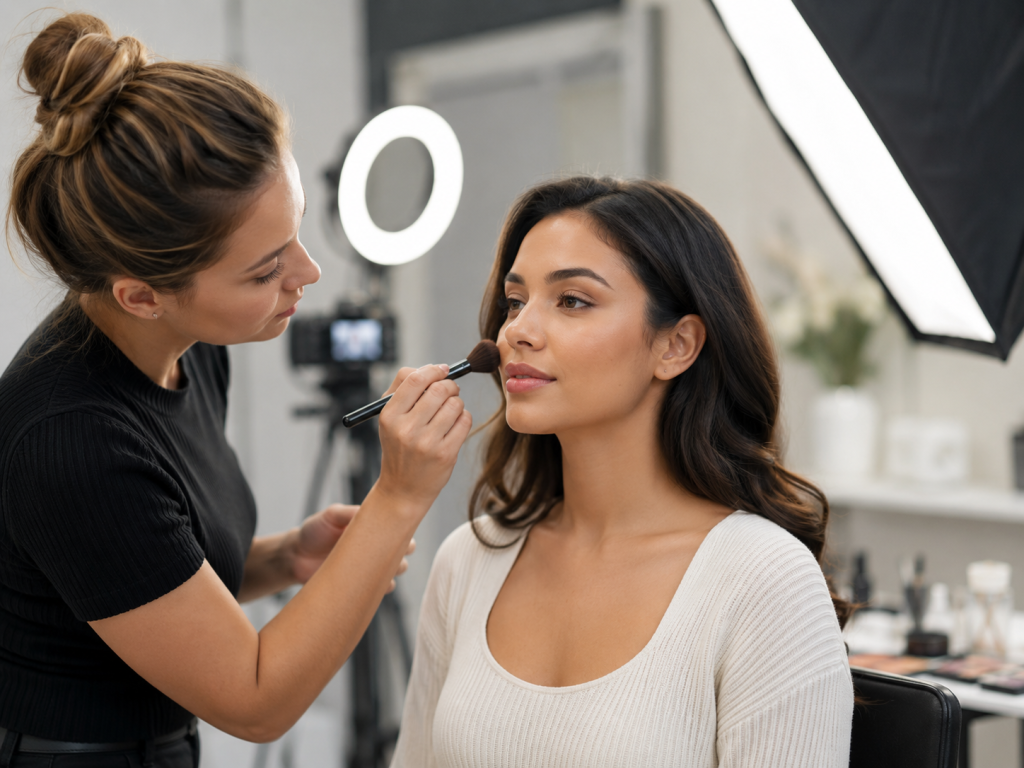
Makeup for Photography Is Not Heavy Makeup
One of the biggest myths about makeup for photography is the idea that it needs to be very heavy.
For many years, camera makeup was associated with thick layers of foundation, intense contouring, excessive powder, and heavily defined eyes. In some specific contexts, such as stage performances, television, or creative productions, a higher level of intensity may be necessary. But in most cases, makeup for photography and video does not mean heavy makeup.
It means well-executed makeup.
The difference lies in the technique.
Heavy makeup can look artificial, emphasise texture, settle into lines, and create an unnatural effect, especially in high-definition images. The camera can easily capture excess product, poorly blended areas, uneven tones, and irregular finishes.
For that reason, more product does not always mean a better result.
Very often, thin and well-worked layers perform better than one thick layer. The skin still looks like skin, but appears more even, balanced, and prepared for lighting.
Foundation should be chosen according to the skin type and the type of image capture. A light-to-medium coverage foundation with buildable potential is usually a very versatile option. It allows the complexion to be evened out without creating a mask effect while adding extra coverage only where needed.
Concealer should also be applied selectively.
Instead of covering everything with foundation, it is better to correct dark circles, redness, blemishes, or small imperfections only where necessary. This approach keeps the makeup looking more natural and comfortable.
Powder should be used carefully.
It is important to control shine, especially in the T-zone, but too much powder can leave the skin looking dry, flat, or more textured. In photography and video, overly matte skin can appear tired. The goal is to control unwanted shine, not remove all the life from the skin.
The same applies to contour, blush, and highlighter.
Everything should be blended properly. Harsh lines can become very obvious in photographs, especially in close-up shots or side lighting. The camera appreciates definition, but it does not respond well to abrupt transitions without intention.
Makeup for photography should look polished, but not masked.
It should feel refined, balanced, and suited to the person. It should enhance the face without transforming it excessively.
The ideal result is one where the person still recognises themselves, but appears more rested, defined, and prepared for the final image.
The Skin: Even, Controlled, and Natural
The skin is one of the most important elements in makeup for photography and video.
It is also one of the areas where the camera most easily reveals mistakes: excess product, uncontrolled shine, emphasised texture, a visible difference in tone between the face and neck, or poorly blended concealer.
For this reason, the skin should be worked on with balance.
The goal is not to create skin without pores or texture. That does not exist in real life. The objective is to even out the complexion, soften small irregularities, control shine, and maintain a natural finish.
Skin preparation is the first step.
Clean, hydrated, and comfortable skin allows makeup to sit better. If the skin is dehydrated, foundation may cling to dry areas. If it is too oily, makeup may move more quickly. If the skin is sensitised, it may react or become uncomfortable during the session.
Hydration should be adapted to the skin type.
Dry skin may need more comfort. Oily skin may benefit from lightweight textures. Combination skin may require hydration in some areas and shine control in others. Sensitive skin should be prepared with gentle, previously tested products.
After preparation, foundation should be applied in thin layers.
It is better to start with a small amount and build coverage only where necessary. The skin looks more real, lighter, and easier to adapt to the camera.
The foundation shade should be chosen very carefully.
In photography and video, even a small difference between the face, neck, and chest can become more noticeable. For that reason, foundation should create harmony between these areas, especially if clothing leaves the neck, shoulders, or neckline visible.
The jawline should be blended thoroughly.
There should never be a visible line between the face and neck. In photoshoots, side angles, and video, this detail can easily become noticeable.
Concealer should be used strategically.
In the under-eye area, it is important to correct without overloading the skin with product. Too much concealer can emphasise lines and create texture. For localised imperfections, it is better to apply a small amount of product and blend the edges carefully.
Shine should be controlled, but not eliminated completely.
The skin needs dimension. Completely matte skin can appear flat and lacking freshness. But excessive shine on the forehead, nose, chin, or under-eye area can look oily on camera.
The ideal balance is natural-looking skin with controlled luminosity and strategically set areas.
In makeup for photography and video, the skin should look refined, not heavy.
When the skin is well executed, the rest of the makeup feels more harmonious.
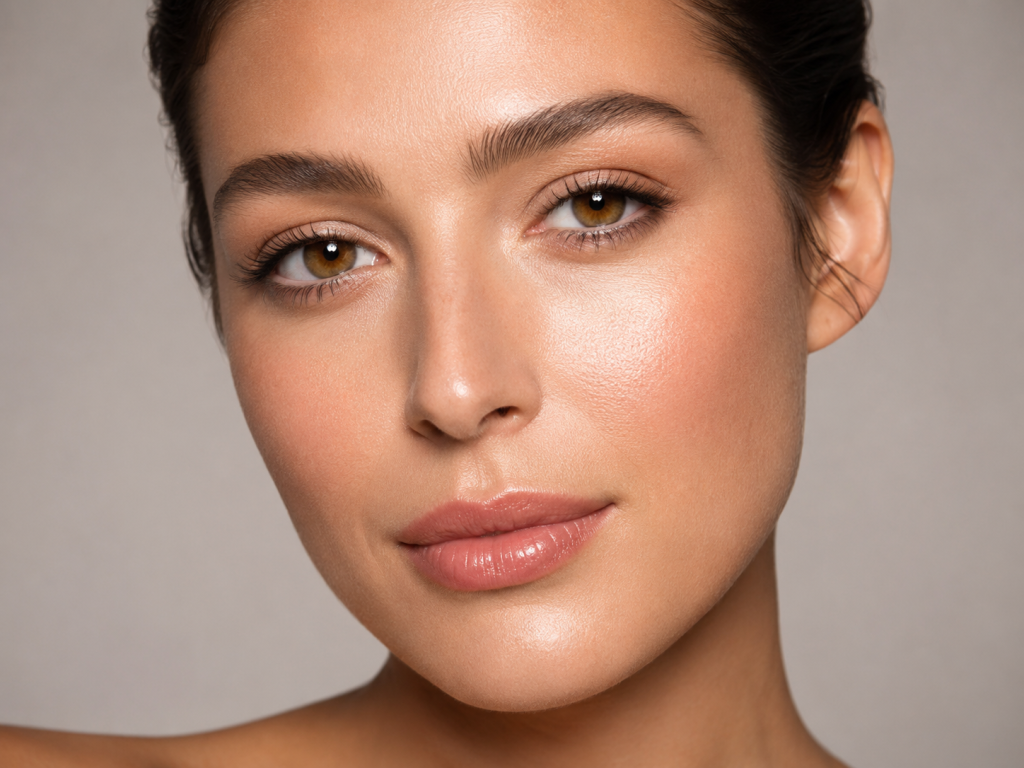
Shine, Flash, and Reflective Products
Shine is one of the most important aspects to control when makeup will be photographed or filmed.
In person, luminous skin can look beautiful, fresh, and healthy. But under flash, studio lighting, or continuous lighting, that shine can become amplified and visually turn into oiliness.
This does not mean the skin has to become completely matte.
It means luminosity should be placed and controlled intentionally.
Areas such as the tops of the cheekbones, the inner corners of the eyes, or the cupid’s bow can receive subtle luminosity when appropriate. Areas such as the forehead, nose, chin, and centre of the face usually require more control because shine tends to appear more strongly in photography and video.
Highlighter should be used carefully.
Products with large particles, glitter, or very intense shimmer can reflect too much light. In photography, they may emphasise texture. In video, they can create distracting points of light. In professional contexts, such as headshots or corporate video, soft and well-integrated luminosity usually creates a more elegant and reliable result.
The same care applies to shimmery eyeshadows.
Satin eyeshadows can work beautifully, but very obvious glitter or shimmer may not be ideal for every type of image capture. In headshots, interviews, or corporate videos, neutral and well-blended eyeshadows usually create a more elegant and dependable result.
Flash can also change the appearance of the skin.
Some products may reflect light in an undesirable way and create a white cast effect, known as flashback. This can happen with certain powders, highly reflective products, or some formulas containing physical sunscreen filters such as zinc oxide or titanium dioxide, especially when used heavily and with direct flash.
This does not mean sunscreen should never be used.
During daytime sessions, especially outdoors, sunscreen remains important. However, it should be selected carefully, tested beforehand, and evaluated in photography when image capture is important.
Products with SPF, translucent powders, and highly reflective foundations should always be tested before important sessions.
Ideally, avoid trying new products on the day of a filming session, photoshoot, wedding, or event involving photography or video.
Makeup for camera work requires predictability.
Understanding how the skin reacts, how the foundation behaves, how the powder sets, and how the highlighter reflects light helps avoid surprises.
The right glow brings life to the face.
The wrong shine can distract attention.
That is why the key lies in control: skin with freshness but without excess; luminosity placed intentionally but without unwanted reflections; a natural finish that is still prepared for lighting and the camera.
How to Adapt Makeup to Lighting
Lighting completely changes the way makeup appears.
Makeup that looks balanced in a softly lit room may appear very different in a studio, outdoors under sunlight, in a room with artificial lighting, or on camera during video recording.
For that reason, before deciding on the intensity of the makeup, it is important to understand the type of lighting that will be used.
There is no need to turn this into something overly technical. But a few considerations can make a significant difference, especially when the final image will be used professionally.
Natural Light
Natural light tends to show the skin in a more realistic way.
For that reason, it requires well-blended makeup, a carefully chosen foundation, and attention to excess product. In natural light, lines from foundation, concealer, blush, or contour can become more noticeable.
At the same time, natural light can be very flattering when the makeup is light, balanced, and well integrated into the skin.
For outdoor sessions or setups near windows, it is important to control shine without removing luminosity completely. The skin should look fresh, even, and natural.
Foundation should be blended carefully into the jawline and neck, because natural light easily reveals differences in tone.
Studio Lighting
Studio lighting can be more intense and direct.
Depending on the setup, it can increase skin shine, soften some definition, or make small texture differences more visible.
In these situations, makeup needs to be slightly more structured. The skin should be well controlled, the eyes and eyebrows should have definition, and the lips should not appear too washed out.
This does not mean using heavy makeup. It means preparing the face for more demanding lighting.
Powder can be useful in strategic areas, especially on the forehead, nose, and chin. However, it should be used in moderation to avoid skin looking too dry or lifeless.
Flash
Flash can significantly change the appearance of makeup.
It can amplify shine, reflect certain products, emphasise excess powder, and reveal differences between the face and neck. It can also make some foundations, concealers, or powders appear lighter than they really are.
For that reason, during flash photography sessions, it is important to avoid highly reflective products, excessive highlighter, and formulas that may create a white cast effect.
The skin should be blended carefully, especially around the jawline, near the ears, and down the neck.
Flash can also remove some depth from the face. Because of this, blush, bronzer, and eye definition should be balanced thoughtfully.
Video Lighting
Video lighting is usually continuous.
It can be soft or intense, warm or cool, depending on the context. In recordings, interviews, corporate videos, or social media content, lighting can warm the skin, increase shine, or reduce contrast.
Makeup for video should take the duration of the recording into account.
The skin needs to withstand time, lighting, and often heat. Shine should be controlled, but the skin should not appear completely matte. The eyes, eyebrows, and lips need enough definition so the face does not disappear on screen.
In video, the person speaks, moves, and expresses themselves. For that reason, the makeup should move naturally with the face without creasing, settling, or looking heavy.
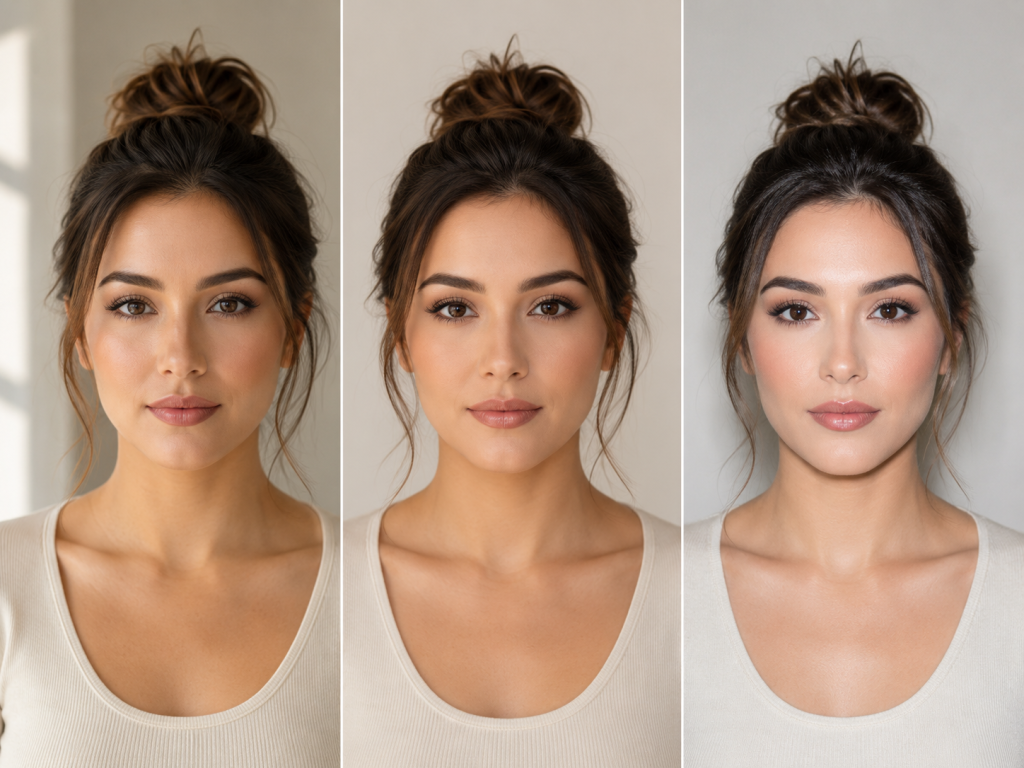
Eyes and Eyebrows: Definition Without Excess
The eyes and eyebrows play an essential role in photography and video.
They are responsible for much of the face’s expression. In headshots, interviews, portraits, corporate videos, and social media content, the eyes communicate presence, confidence, and attention.
The camera can soften some definition. As a result, eye makeup that appears sufficient in person may look almost invisible on camera.
Even so, the goal is not to create an overly heavy eye look.
The balance lies in subtle definition that is well blended and appropriate for the context.
Neutral eyeshadows usually work very well in photography and video. Shades such as beige, soft brown, taupe, subtle bronze, champagne, mauve, or neutral pink help create depth without becoming distracting.
In professional contexts, such as headshots, interviews, or corporate videos, it is usually best to avoid glitter, very intense shimmer, or overly dramatic eyeshadow unless the visual direction of the production specifically calls for that effect.
A subtle eyeliner can help significantly.
It does not need to be a graphic or highly visible eyeliner. Very often, a thin line close to the lashes, a softly blended brown pencil, or a dark eyeshadow applied along the lash line is enough to give the eyes more presence.
Mascara is another important element.
It helps open the eyes, define the gaze, and prevent the face from looking tired on camera. For video or photography, it may be useful to choose a long-wearing formula, especially if there will be strong lighting, heat, or many hours of filming.
Eyebrows should also be carefully groomed.
They do not need to be heavily defined. In fact, overly drawn eyebrows can harden the expression and appear artificial in close-up shots.
The ideal approach is to brush them into place, fill small gaps, and maintain their natural shape.
In photography and video, well-defined eyebrows help frame the face. But they should still remain soft and integrated into the makeup.
The eyes should gain presence without losing naturalness.
Blush, Bronzer, and Contour on Camera
The camera can alter the perception of the face’s structure.
In some photographs or videos, lighting can “flatten” facial features, reducing dimension in the face. For that reason, products such as blush, bronzer, and contour can help restore shape, freshness, and balance.
However, they should be used carefully.
Blush is one of the most important products in makeup for photography and video.
The camera can remove some of the face’s natural colour, especially under strong lighting. Well-applied blush helps restore life, freshness, and expression.
Pink, peach, mauve, or soft terracotta tones can work beautifully, depending on the skin tone and the purpose of the image.
Blush should always be blended carefully.
In photography, a poorly blended patch of blush can become very noticeable. The ideal approach is to apply a small amount of product, build gradually, and ensure the edges remain soft.
Bronzer helps warm up the face.
It can be applied to the areas where the sun would naturally hit: the sides of the forehead, the cheekbones, and the perimeter of the face. On camera, it helps prevent the skin from appearing too flat or pale.
However, the shade must be chosen carefully.
A bronzer that is too orange, too dark, or too harsh can appear artificial. The application should remain light and well integrated.
Contour serves a different purpose.
While bronzer adds warmth, contour creates shadow and definition. It can help structure the face in photography, but it should be used far more subtly than what is often seen on social media.
Very harsh contour lines can become visible in close-up shots or side lighting.
For photography and video, contour should be subtle, well blended, and adapted to the face. The goal is to create dimension, not draw visible lines.
It is also important to choose suitable finishes.
Matte or satin products are usually safer on camera than products with intense shimmer. A touch of luminosity can look beautiful, but too much shine may reflect excessively.
Face makeup for camera work should restore shape and life to the face without looking artificial.
Lips for Photography and Video
Lips have more impact on camera than many people realise.
In photography and video, lips that are too muted can make the face appear tired or expressionless. On the other hand, very dark or highly intense lips may require constant maintenance and can become the main focus of the image.
The choice should depend on the objective.
For professional headshots, corporate videos, or interviews, natural shades with a little presence usually work very well. Pinks, rosy nudes, mauves, peaches, pink-beiges, or soft browns can bring life to the face without appearing excessive.
For campaigns, editorials, or creative productions, there may be room for stronger tones depending on the brief and the visual identity.
Texture also matters.
Very matte lipsticks may last longer, but they can dry out the lips and emphasise texture. Very creamy lipsticks may feel comfortable but transfer more easily. Glosses can look beautiful, but in video or photography they may reflect light and require more touch-ups.
In many situations, a controlled creamy texture, satin finish, or semi-matte formula can be an excellent option.
Lip liner can also help.
It does not need to create a very harsh outline. It can simply define the natural shape of the lips softly, help the lipstick last longer, and prevent it from fading unevenly.
For video, longevity is especially important.
The person speaks, drinks water, takes breaks, and may spend several hours recording. For that reason, it is useful to choose a product that is comfortable, long-wearing, and easy to touch up.
It is also important to hydrate the lips beforehand.
Dry lips or loose skin can become more visible in close-up shots. Simple preparation helps lipstick sit more smoothly.
Ideally, the lips should have enough presence to balance the face without stealing attention when that is not the intention.
Differences Between Photography, Video, and Headshots
Makeup for camera work is not always the same.
A professional profile photo, a corporate recording, a brand campaign, and a bridal session all have different requirements.
The common point is adapting to the lighting and the final image. But the intention changes.
Professional Headshots
In headshots, the goal is to create a polished, professional, and approachable image.
The makeup should enhance the person without looking too obvious. The skin should be even, shine controlled, eyes defined, and eyebrows well-groomed.
The result should convey confidence, approachability, and professionalism.
In this context, it is best to avoid overly trendy makeup, very strong shimmer, intense eyeshadows, or lips that distract too much attention.
The person should look like themselves, but in a more polished version.

Corporate Video or Interview
In video, makeup needs to withstand movement, speech, continuous lighting, and long recording times.
Shine should be controlled, especially in the centre of the face. The eyes need definition to maintain presence. The lips should have enough colour not to disappear on camera.
Makeup should not look heavy in close-up shots, but it should also not be so subtle that the camera washes it out.
In interviews, webinars, corporate videos, or training sessions, the image should look polished, natural, and aligned with the professional context.
Brand Photoshoot
In a brand photoshoot, makeup depends heavily on the brief.
A corporate brand may request a very natural, clean, and professional look. A fashion, beauty, lifestyle, or creative brand may allow more colour, texture, or expression.
In these cases, makeup should align with the brand’s visual identity, the clothing, the lighting, the set, and the campaign’s purpose.
Makeup is no longer purely individual. It becomes part of the visual language of the production.
Brides in Photography and Video
Bridal makeup has a particular challenge.
It needs to look beautiful in person, feel comfortable for many hours, and withstand emotion, but it also has to perform well in photography and video.
Lighting can vary throughout the day: getting ready, ceremony, outdoor, indoor, cocktail hour, dinner, dancing, and flash photography at night.
For that reason, makeup should be balanced and long-lasting.
The skin should look natural but prepared. The eyes should have enough definition. Blush and lips should not disappear. The face, neck, and chest should be harmonised.
The bride should feel like herself, but also confident that the makeup will look good in the images she will keep forever.
How to Prepare Before a Photoshoot or Recording
Makeup for photography and video starts before the application of products.
How the skin arrives at the session, the information shared with the makeup artist, and the organisation of the day all strongly influence the final result.
It is not necessary to have a complicated preparation. In most cases, the most important thing is to avoid last-minute experiments, keep the skin comfortable, and ensure the makeup is designed for the right context.
Before a photoshoot, recording, interview, or any event involving camera work, it is useful to understand a few key details:
- what type of images will be captured;
- where the session will take place;
- whether there will be natural light, studio lighting, flash, or video;
- what the purpose of the images is;
- what clothing will be worn;
- whether there are brand colours or references;
- how long the session will last;
- whether close-up shots will be required;
- whether touch-ups will be needed;
- whether the makeup should be more natural, professional, editorial, or sophisticated.
This information helps define the intensity of the makeup.
A headshot makeup look does not need to match the intensity of a fashion campaign. A video interview does not require exactly the same approach as bridal makeup. A brand production may require stronger alignment with colours, styling, and visual identity.
The clearer the objective, the more precise the makeup will be.
Skin preparation is also important.
In the days leading up to the session, it is best to keep a simple and familiar routine. Gentle cleansing, proper hydration, and daily sun protection are good starting points.
It is advisable to avoid trying new products close to the session. Even a high-quality product can cause reactions, redness, breakouts, irritation, or flaking on skin that is not used to it.
Aggressive treatments should also be avoided near the date.
Peels, deep facials, strong exfoliation, laser treatments, or anything that may sensitise the skin should be scheduled in advance. Makeup performs best when the skin is calm and comfortable.
The day before and the day itself, it helps to keep things simple: drink water, rest when possible, and avoid anything that could irritate the skin.
On the day of the session, the skin should arrive clean and without excess product.
Heavy creams, dense oils, or overly shiny products can interfere with foundation and longevity. When in doubt, it is best to follow the makeup artist’s guidance.
It is also important to communicate any allergies, sensitivities, or product intolerances.
If the person has rosacea, active acne, very dry skin, dermatitis, watery eyes, or frequent reactions, this should be shared in advance so the preparation can be adapted.
For longer sessions, recordings, or events, touch-ups may be necessary.
Skin shine, lips, and high-movement areas may need simple maintenance. Having blotting paper, compact powder, lipstick, and cotton swabs can help keep the look polished.
Good preparation does not mean complication.
It means arriving at the session with stable skin, the right information, and enough time for makeup to be done calmly.
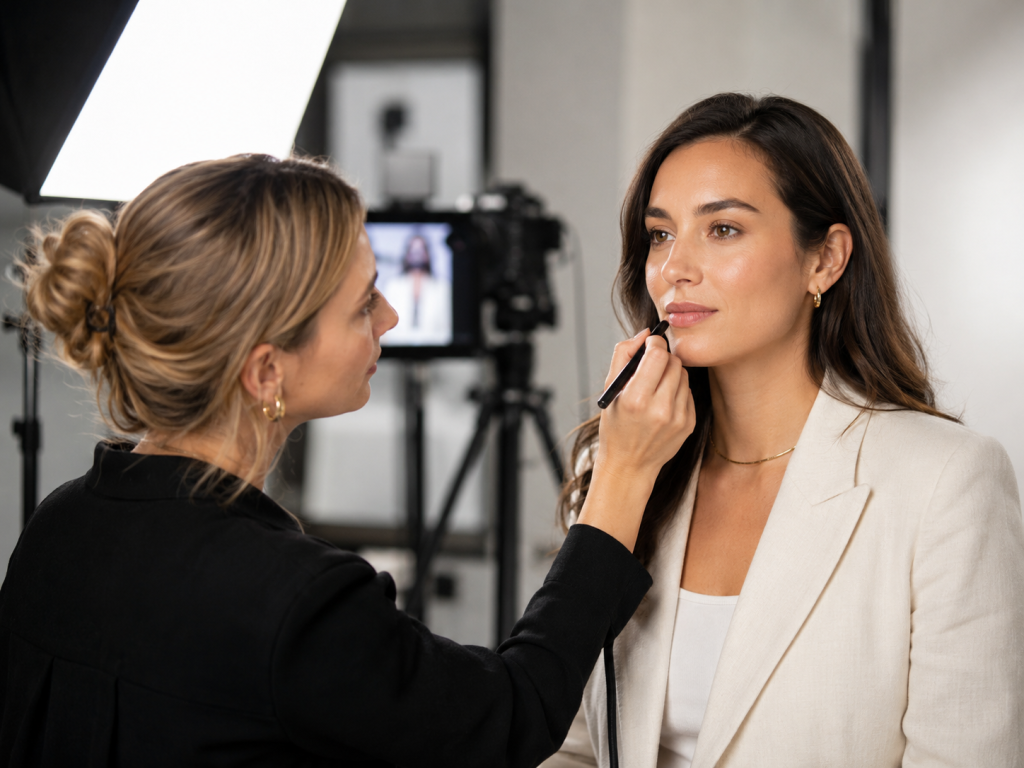
Common mistakes in makeup for photography and video
Makeup for photography and video requires balance.
Small mistakes that may seem subtle in real life can become more visible on camera, especially under strong lighting, flash, close-up shots, or high-definition video.
Knowing the most common mistakes helps avoid them.
Using too much foundation
Excess foundation may seem like a solution for evening out the skin, but in photography and video it can have the opposite effect.
Heavy layers can emphasize texture, settle into lines, break down over time, and create an artificial finish.
The skin should look refined, not masked.
The ideal approach is to apply a thin layer, build only where needed, and correct specific areas with concealer.
Ignoring the lighting
Lighting is one of the most important factors.
Makeup applied without considering the lighting conditions of the shoot can look unbalanced. Natural light reveals texture and blending. Studio light can enhance shine. Flash can reflect certain products. Video lighting can flatten contrast or increase oiliness.
Before doing makeup, it is essential to know the conditions under which the images will be captured.
Overusing highlighter
Highlighter can be beautiful, but it should be used with care.
On camera, too much shine can look like oiliness, emphasize texture, or create unwanted reflections. Products with large particles or heavy shimmer can become too visible.
Luminosity should be subtle and well placed.
Choosing lips that are too pale
Very nude or very light lips can disappear in photography and video.
When this happens, the face may look tired or less expressive. It is not necessary to use strong lipstick, but it is important to choose a shade that brings life and definition to the lips.
Natural tones with presence usually work very well.
Not defining eyebrows and lashes
The camera can soften facial features.
If eyebrows and lashes lack definition, the eyes may lose presence, especially in video or headshots.
No heavy definition is needed. Simply groom, fill small gaps, and apply mascara to open up the eyes.
Not blending properly
Foundation, concealer, blush, bronzer, contour, or eyeshadow lines become more noticeable in photography.
Blending is essential.
Makeup should have soft transitions, especially around the jawline, hairline, nose, under-eyes, and areas where colour products are applied.
Testing new products on the day
This mistake can compromise the result.
New products may oxidise, separate, create shine, cause flashback, irritate the skin, or simply not perform well.
Before an important shoot, it is best to use already-tested products or rely on a professional makeup artist who knows how to adapt products to the skin and lighting.
Using too much powder
Powder helps control shine, but in excess it can make the skin look dry, heavy, and textured.
In photography, overly powdered skin can appear artificial. In video, it can emphasise lines and movement in the skin.
Powder should only be applied where necessary.
Forgetting the neck and décolletage
When the face is made up and the neck or chest are visible, it is important to ensure harmony.
Differences in tone between the face, neck, and décolletage can easily show in photography and video.
Makeup should be well blended and adapted to the overall image.
Checklist for photography and video makeup
Before a shoot, recording, or any event involving camera work, this checklist can help organise the essentials.
Confirm:
- type of capture: photography, video, or both;
- purpose of the images;
- location of the shoot or recording;
- time schedule;
- expected duration;
- presence of natural light;
- presence of studio lighting;
- use of flash;
- continuous video lighting;
- close-up shots;
- outfit and main colours;
- visible neckline, neck, or shoulders;
- brand identity, if applicable;
- desired style: natural, professional, sophisticated, or editorial;
- skin type;
- tendency to shine;
- dry or sensitive areas;
- allergies;
- products to avoid;
- need for touch-ups;
- breaks available for maintenance;
- lipstick for touch-ups;
- powder or blotting papers;
- required makeup longevity;
- room temperature;
- possibility of heat or sweating;
- time available for makeup;
- production contact person, if any.
For the skin, also confirm:
- no new products were tested in the days leading up to the session;
- aggressive treatments were avoided close to the shoot;
- adequate hydration was maintained;
- the skin arrived clean;
- any sensitivities or usual reactions were communicated;
- heavy creams were avoided on the day itself.
This checklist is especially useful in professional contexts such as headshots, interviews, corporate videos, campaigns, events, content production, and brand photography.
The clearer the brief, the more refined the result.
Makeup should respond to the face, but also to the final image.
Conclusion: makeup should serve the final image
Makeup for photography and video should not be designed only for the mirror.
It should be designed for the lighting, the camera, the type of capture, and the purpose of the image.
Good camera makeup is not necessarily heavier. It is more strategic.
The skin should be even but natural. Shine should be controlled without removing life from the face. Eyes and brows should have enough definition to maintain expression. Blush and lips should add presence without drawing too much attention. Everything should be well blended, balanced, and adapted to the context.
The same makeup does not work for every scenario.
A professional headshot requires a polished and approachable image. A corporate video requires durability and shine control. A brand campaign may allow more visual expression. A bride needs naturalness, longevity, and emotion. An interview or corporate event requires presence without excess.
The key is understanding the purpose.
When makeup is well adapted, the person appears more refined, confident, and aligned with the image they want to project.
The camera should not reveal makeup as a heavy layer.
It should reveal the person, with more balance, definition, and presence.
This is the role of makeup for photography and video: to serve the final image without losing authenticity.
Frequently asked questions about makeup for photography and video
Should makeup for photography be stronger?
Not necessarily.
It may require more strategic definition, but it should not automatically be heavier. The camera can soften some features, so eyes, brows, blush, and lips may need slightly more presence.
The goal is to maintain naturalness with enough definition for the image.
Is video makeup different from photography makeup?
Yes.
Video involves movement, speech, continuous lighting, and duration. Makeup must withstand time, control shine, and maintain expression throughout the recording.
Photography focuses more on the instant, flash, lighting conditions, and close-up framing.
Can I use SPF makeup for photography?
It depends on the formula and lighting.
Some SPF products, especially those with mineral filters or reflective particles, can cause a white cast under flash. For important shoots, testing beforehand is recommended.
For outdoor daytime sessions, sunscreen is still important, but it should be compatible with makeup and camera work.
How do I avoid shine on camera?
Skin preparation, foundation choice, moderate use of powder, and blotting papers all help control shine.
The key is to mattify only where needed—such as the forehead, nose, and chin—without making the skin completely lifeless.
What makeup works best for headshots?
For headshots, a natural, polished, and professional look works best.
The skin should be even, shine controlled, brows groomed, lashes defined, and lips with natural colour.
The goal is to convey confidence and approachability.
Should I use highlighter for photography?
You can, but in moderation.
Subtle highlighter can add freshness to the face. Too much shine, glitter, or reflective particles can emphasise texture and create unwanted highlights.
In professional contexts, controlled luminosity is usually best.
What lipstick should I use for video?
The ideal choice is a comfortable, long-wearing lipstick with enough colour not to disappear on camera.
Natural tones with presence—such as pink, mauve, rosy nude, or peach—usually work well. For long recordings, it is useful to have the lipstick available for touch-ups.
Should I hire a makeup artist for a photoshoot?
It makes sense when the images will be used professionally.
Headshots, campaigns, corporate videos, interviews, brand photography, bridal work, corporate events, and productions benefit from makeup adapted to lighting, camera, and the purpose of the image.
A professional makeup artist helps avoid mistakes that can appear in photography or video.
What should I avoid before a shoot?
Avoid new products, aggressive treatments, strong exfoliation, untested self-tanner, and heavy creams on the day itself.
The skin should arrive calm, clean, and comfortable.
Should camera makeup look natural in real life?
Yes, whenever that is the goal of the shoot.
Camera makeup should be designed for lighting and the final image, but it does not need to look artificial in person. The balance lies in creating definition and finish without excess.
Are you preparing for a photoshoot, recording, interview, or campaign?
Makeup for photography and video should be designed for lighting, camera, and the purpose of the image.
Filipa Villar Afonso provides professional makeup for photography, video, productions, brands, interviews, and events, adapting the result to the face, skin type, and capture context.
If you are preparing for a shoot, recording, or production, you can send the details to receive a personalised proposal.