Bridal makeup is much more than just beautiful makeup.
It is a choice designed for a long, emotional day full of important moments. It must work in person, in photography, and on video. It must withstand hugs, tears, heat, movement, and many hours of celebration. And, above all, it should make the bride feel beautiful, comfortable, and true to herself.
That is why bridal makeup should not be chosen only based on a trend or a beautiful image seen on social media.
It should take into account the bride’s face, skin type, dress, hairstyle, accessories, wedding location, ceremony time, lighting, season, photography, and how the bride wants to feel on that day.
Some brides look for very natural, luminous, and subtle makeup. Others prefer a more classic, romantic, sophisticated, or glamorous result. None of these options is wrong. The important thing is that the look is designed for the real bride and the real wedding.
Good bridal makeup should enhance without transforming, correct without weighing down, and illuminate without looking artificial.
In this guide, I explain the main points to consider when choosing bridal makeup, preparing the skin, doing the trial, ensuring durability, and arriving on the wedding day with more confidence and calm.
What makes bridal makeup different?
Bridal makeup has very specific demands.
It is not the same as everyday makeup, nor as regular party makeup. It can still look natural and light, but it needs to be designed with more detail because it must last many hours and adapt to very different situations.
On the wedding day, makeup will be seen up close during greetings, hugs, and conversations. It will be seen from a distance during the ceremony. It will be photographed in many moments. It will be filmed in motion. And it must withstand emotion, heat, tears, dancing, kisses, and the passing of hours.
Therefore, it is not enough for makeup to look good right after application.
It needs to stay beautiful throughout the entire day.
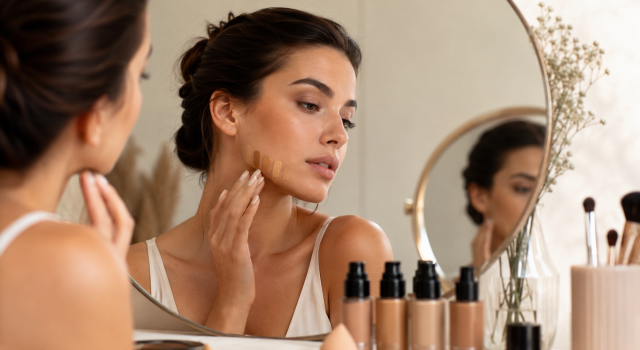
The skin must be well prepared, the foundation must suit the skin type, products must be carefully chosen, and application must balance naturalness with durability.
Another important point is photography and video.
Makeup that looks perfect in the mirror may behave differently under camera flash or natural light. Skin that is too shiny may look oily. Skin that is too matte may look flat. Makeup that is too soft may disappear in photos. Makeup that is too heavy may look artificial.
Balance is essential.
Bridal makeup must also respect the overall look. The dress, hairstyle, bouquet, accessories, and wedding location all influence the makeup choice. A beach ceremony during the day may require a different approach than an evening wedding in a formal venue.
Still, there are no strict rules.
A bride may want a natural look for an evening wedding. Another may prefer more defined eyes for an outdoor ceremony. The important thing is that the makeup makes sense for that person, that face, and that context.
The main difference lies in intention.
Bridal makeup should be personalized, durable, comfortable, and designed to create a cohesive look from the beginning to the end of the day.
It should not be a mask.
It should be a more refined, luminous, and confident version of the bride herself.
Bridal makeup should look like you
The ideal bridal makeup is not necessarily the most natural, the most dramatic, the most trendy, or the most photographed.
It is the one that makes sense for you.
On the wedding day, the bride should look in the mirror and recognize herself. She should feel special, of course, but not like she has become someone else.
This point is very important.
Many brides reach the makeup selection stage with several references saved: Pinterest images, Instagram posts, editorial looks, celebrities, or other brides. These images can be useful, but they should not erase the bride’s own identity.
A makeup look can be very beautiful in an image and still not suit your face, skin, style, or wedding.
Therefore, before choosing colors or intensity, it is worth asking a simple question: how do you want to feel on your wedding day?
Do you want to feel light and natural?
More sophisticated?
Romantic?
Classic?
Confident?
Glamorous?
Very close to your everyday look?
Or a little more made-up than usual?
These answers help guide the choice.
It is also important to consider the bride’s relationship with makeup.
If she rarely wears makeup, a very intense look might feel strange or uncomfortable. Even if it looks good in photos, it may not make her feel like herself.
On the other hand, if the bride usually wears eyeliner, full-coverage skin, defined lashes, or colored lipstick, a very subtle makeup look may feel insufficient.
The goal is not to follow a rule, but to find balance.
Bridal makeup should elevate the bride’s image, not erase it. It should enhance features, brighten the face, balance the skin, and build confidence while staying connected to the real person.
A good result is one that feels naturally right: not necessarily “almost no makeup,” but natural for that bride.
Natural can mean luminous skin and soft eyes. But it can also mean a red lipstick if that lipstick is part of the bride’s identity. It can mean defined eyes if that makes her feel secure. It can mean more noticeable lashes if that detail fits the overall look.
Bridal makeup should not be an imposition.
It should be a process built with listening, adaptation, and care.
The bride should feel that the makeup accompanies her, not competes with her.
Types of bridal makeup
There are several styles of bridal makeup, and each can be adapted to the face, skin, dress, and wedding environment.
These styles should not be seen as rigid categories. Often, the final look mixes elements of several: natural with romantic, classic with luminous, glamorous with elegant.
Still, understanding the differences helps guide the choice.
Natural bridal makeup
Natural bridal makeup is one of the most popular choices.
It usually enhances light, luminous, and fresh skin with subtle corrections, soft eyes, and lips in tones close to the natural color.
It is ideal for brides who want to stay very close to their usual appearance but with a more polished and long-lasting result.
However, natural does not mean no makeup.
Natural bridal makeup can require a lot of technique. The skin must be evened without heaviness, shine controlled without removing glow, the eyes defined without over-darkening, and the result must last throughout the day.
The goal is for the bride to look rested, radiant, and confident without makeup being too noticeable.
This style works very well for outdoor weddings, daytime ceremonies, intimate weddings, or brides who prefer a discreet and elegant aesthetic.
Classic bridal makeup
Classic bridal makeup aims for a timeless result.
It is the type of makeup that still looks elegant in photos many years later. It usually focuses on balanced skin, defined eyes with neutral tones, enhanced lashes, and subtle or softly present lips.
It does not follow strong trends.
The strength of this style lies in harmony.
Classic makeup adapts well to many wedding types: religious ceremonies, civil weddings, formal venues, estates, hotels, or traditional celebrations.
It is a good choice for brides who want to feel elegant, polished, and secure without going too minimal or too intense.
In this style, details make a difference: well-prepared skin, groomed brows, softly defined eyes, and well-chosen lips create a very balanced result.
Romantic bridal makeup
Romantic bridal makeup is soft, feminine, and delicate.
It usually uses pink, peach, champagne, mauve, or soft brown tones. The skin tends to be luminous, the eyes are enhanced gently, and the lips remain natural.
This style pairs very well with lace dresses, light fabrics, delicate bouquets, countryside weddings, outdoor ceremonies, or softer and more emotional settings.
Romantic makeup does not need to be overly subtle. It can include defined eyes, beautiful lashes, and well-worked skin, but the final result should feel soft.
It is a good option for brides who want a sweet, elegant, and luminous image without losing naturalness.
Glamorous bridal makeup
Glamorous bridal makeup has more presence.
It may include more defined eyes, stronger lashes, deeper eyeshadows, more polished skin, or more prominent lips.
This style works very well for evening weddings, formal venues, structured dresses, or brides who enjoy a more sophisticated image.
But glamour does not mean excess.
Glamorous bridal makeup should still feel elegant, balanced, and appropriate for the person. The goal is not to create a heavy or theatrical look, but to add definition and impact to the face.
This style works best when aligned with the bride’s personality. If she already enjoys makeup, wears more defined looks, or wants to feel more made-up on her wedding day, it can be an excellent choice.
The secret lies in adjusting intensity, colors, and finish so that the result remains comfortable and harmonious.
Bridal makeup for a civil wedding
Makeup for a civil wedding can vary a lot.
Some brides prefer a simple, fresh, and subtle look. Others choose more sophisticated makeup, especially if the civil ceremony includes a more formal celebration, lunch, dinner, or a photo session.
The choice depends on the dress, location, time, and style of the ceremony.
A short and minimalist dress can pair well with natural and elegant makeup. A modern white suit may allow for more defined eyes or more present lips. An intimate civil ceremony may call for lightness. A larger civil celebration may justify more structured makeup.
The important thing is not to underestimate the civil wedding.
Even when the event is simpler, makeup can help the bride feel cared for, confident, and ready for the photos and emotions of the day.
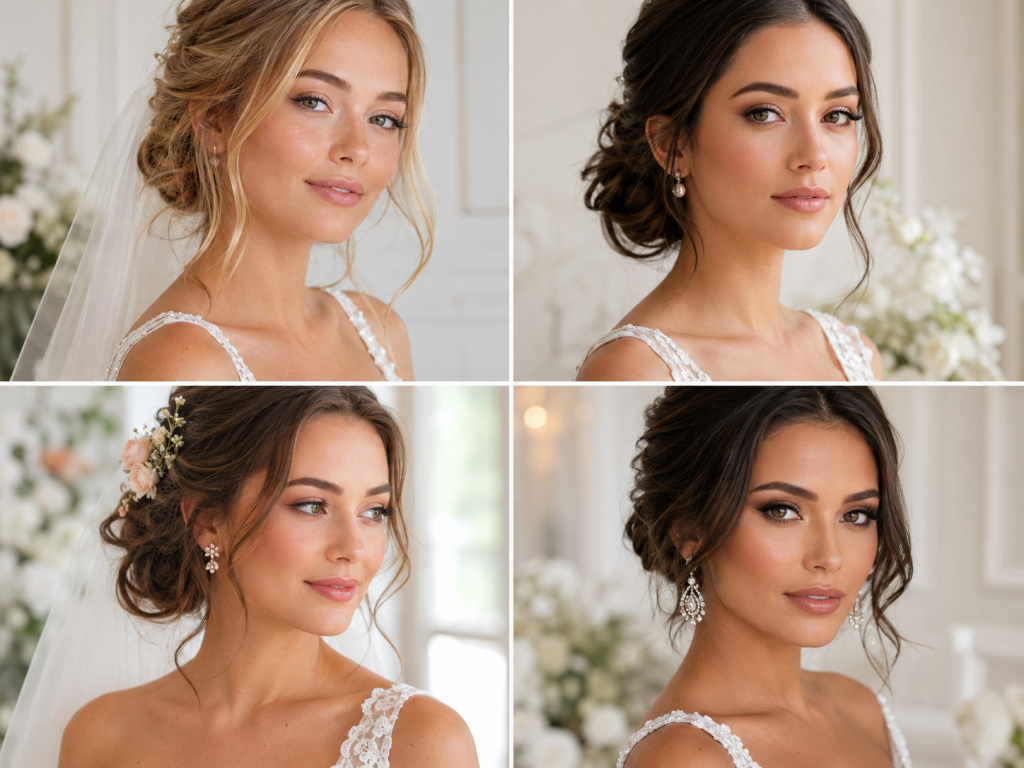
How to choose the right wedding look
Choosing a bridal makeup look should not be an isolated decision.
Makeup should interact with all elements of the wedding: dress, hairstyle, accessories, bouquet, location, time, season, photography, and overall atmosphere.
The dress is one of the first points to consider.
A romantic dress with lace and delicate details may call for soft, luminous, and feminine makeup. A minimalist dress with clean lines can pair well with a more polished, modern, or structured look. A very sophisticated dress may allow for more definition in the eyes or lips.
The hairstyle also influences the choice.
An updo leaves the face more exposed, which may require more balance between skin, eyes, and lips. Loose hair or soft waves can create a more romantic and natural look. Hair accessories, veils, earrings, and necklaces are also part of the overall composition.
The location and time of the ceremony are equally important.
A daytime outdoor wedding may favor fresher and more luminous makeup. An evening wedding or indoor venue may allow for more intensity and structure.
The season can also influence the choice.
In summer, it is important to consider heat, sweat, and durability. In winter, it may make sense to focus on skin comfort and textures that do not emphasize dry areas. In any season, makeup should be adapted to the skin type and the real context of the day.
Photography and video should also be considered.
Makeup needs to work in real life but also on camera. Therefore, it may be necessary to add a bit more definition to eyes, brows, and lips, even in a natural look.
The most important thing is to aim for coherence.
Makeup should not feel separate from the rest of the look. It should be part of the whole and help the bride feel her best.
To choose the right look, it can help to think about these questions:
- Is the dress more romantic, classic, modern, or sophisticated?
- Will the wedding be during the day or at night?
- Will it be outdoors or indoors?
- Will the ceremony be formal or casual?
- Does the bride usually wear makeup in everyday life?
- Does she want a natural, classic, romantic, or glamorous result?
- Will there be a lot of photography or video?
- Does the skin have any specific needs?
- Does the chosen look feel comfortable for many hours?
When these answers become clearer, choosing makeup becomes much easier.
The ideal bridal makeup does not come from a trend.
It comes from the balance between what enhances the bride, what works technically, and what makes sense for the wedding.
How to use inspiration images without copying a makeup look
Inspiration images are very useful when choosing bridal makeup.
Pinterest, Instagram, magazines, editorials, photos of other brides, and even celebrity images can help identify tastes, styles, and preferences. Often, a bride may not yet know how to describe exactly what she wants, but she can show images that feel close to her vision.
And that can be a great starting point.
However, it is important to remember that a reference should guide, not be copied exactly.
A makeup look that is beautiful in one photo may not have the same effect on a different face. Every person has different features: eye shape, skin tone, texture, brows, lips, bone structure, expression, and personal style.
In addition, many online images include filters, editing, professional lighting, controlled angles, and sometimes makeup designed only for photography.
What looks very natural in an image may actually involve a lot of product. What looks luminous may depend on very specific lighting. What looks perfect may have been edited.
Therefore, instead of trying to copy an image, it is more important to understand what you like about that reference.
Is it the glowing skin?
The soft eyes?
The lip color?
The overall natural feel?
The lash definition?
The harmony between skin and eyes?
The sense of elegance?
These answers are much more helpful than trying to reproduce everything exactly.
The ideal approach is to gather a small number of well-chosen images. Three to five references are usually enough to understand the intended direction. Too many images can make the process confusing, especially if they show very different styles.
It is also useful to bring examples of what you do not like.
Sometimes, it is easier to define boundaries when the bride shows makeup looks she wants to avoid: overly heavy skin, very dark eyes, strongly defined brows, excessive shine, overly washed-out lips, or makeup that looks too artificial.
During the makeup trial, these references help start the conversation.
Afterwards, the look should be adapted to the real bride: her face, her skin, her dress, her hairstyle, the location, the ceremony time, and how she wants to feel.
Inspiration is only the starting point.
The final makeup should be personalized.
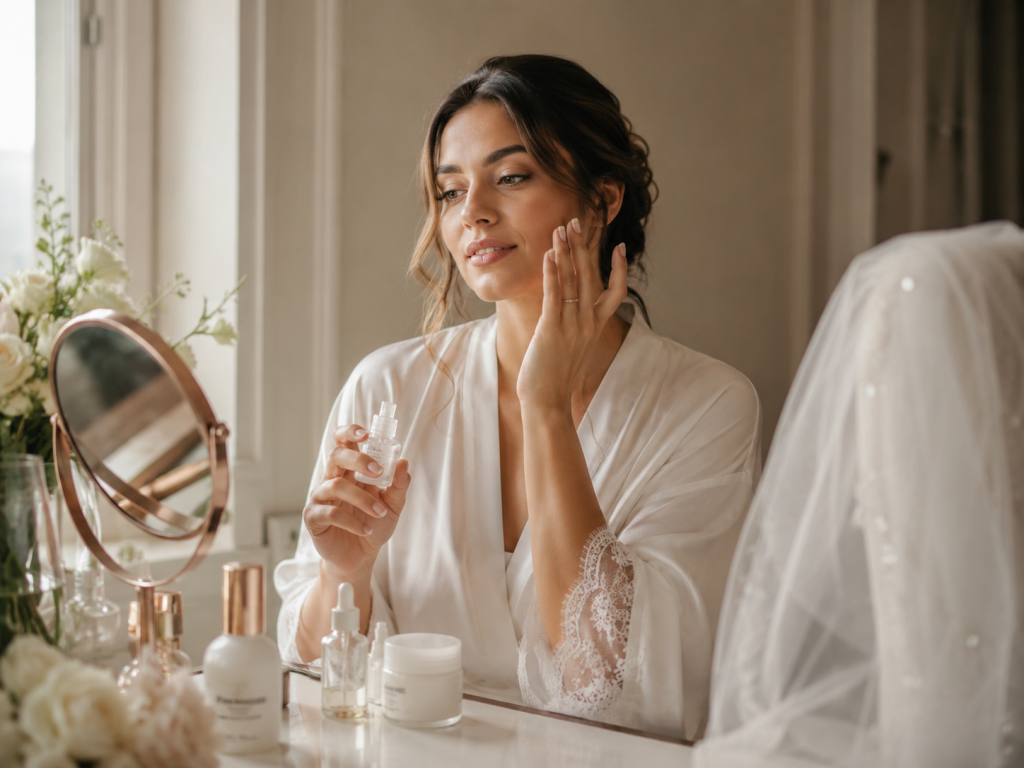
Skin preparation before the wedding
Bridal makeup starts before the wedding day.
It begins with how the skin is cared for in the weeks or months leading up to it. Well-prepared skin helps makeup apply more smoothly, look more natural, and last longer in comfort.
But preparing the skin does not mean aiming for perfect skin.
Real skin has texture, pores, small marks, dry areas, shine, redness, or sensitivity. All of this is normal. Professional makeup works with real skin, not filtered skin.
The goal of skin preparation is balance.
More hydrated, calm, and comfortable skin allows for more beautiful and long-lasting makeup. Foundation blends better, concealer creases less, shine is controlled more evenly, and the final result looks more natural.
The most important thing is to start with simple and consistent care.
Gentle cleansing, proper hydration, and sunscreen are a good foundation for almost all skin types. After that, more specific care can be introduced depending on each bride’s skin type and needs.
Dry skin may need more comfort and hydration. Oily skin may benefit from balance and shine control. Sensitive skin requires gentleness and well-tolerated products. Skin prone to spots, acne, or redness may need professional support well in advance.
What should be avoided is trying to fix everything in the last few days.
New products, aggressive exfoliation, intensive treatments, or last-minute experiments can cause redness, flaking, breakouts, or sensitivity. And that can make makeup more difficult exactly when the skin should be calm.
Skin preparation should be gradual.
6 months before
If there are still several months before the wedding, this is a good time to observe the skin and understand what it needs.
It may be the right moment to build a simple routine, consult a professional if there is acne, rosacea, pigmentation, or sensitivity, and introduce targeted care with enough time to evaluate how the skin reacts.
If it makes sense to use active ingredients such as vitamin C, gentle acids, or retinoids, this should be done with guidance and in advance. These products can bring benefits, but they may also require an adjustment period.
With several months ahead, there is time to test, adjust, and understand what works.
3 months before
Three months before the wedding, the skin can still improve significantly with consistency.
At this stage, the focus should be on maintaining a stable routine, reinforcing hydration, and avoiding drastic changes. If a routine already works, there is no need to change everything.
Professional treatments can be done if appropriate, but they should be planned carefully. Any procedure that causes redness, peeling, or sensitivity should have enough recovery time.
It is also a good time to observe how the skin behaves throughout the day: whether it becomes oily, feels tight, flakes, turns red, or reacts easily.
These insights are very useful for the makeup trial.
1 month before
When there is one month left, the main rule is: do not complicate things.
This is not the time to try new products, change the entire routine, or do aggressive treatments. The focus should be on keeping the skin calm, hydrated, and predictable.
If the skin is dehydrated, it may help to reinforce hydration with already familiar products. If there are dry areas, they should be cared for. If the skin is oily, hydration should not be removed, but adjusted.
One month before the wedding, the goal is refinement, not transformation.
Wedding week
In the wedding week, less is more.
No new products should be introduced. It is not advisable to try unknown masks, strong exfoliation, deep cleansing, or intensive treatments. Even good products can cause reactions on skin that is not used to them.
The routine should stay simple, using only tested products.
Gentle cleansing, hydration, sunscreen, and rest whenever possible are the best allies.
If a pimple or irritation appears, the most important thing is not to over-touch it. Trying to force a solution can make it worse and leave marks that are harder to correct.
In the wedding week, the skin needs calm.
And calm skin is an excellent base for bridal makeup.
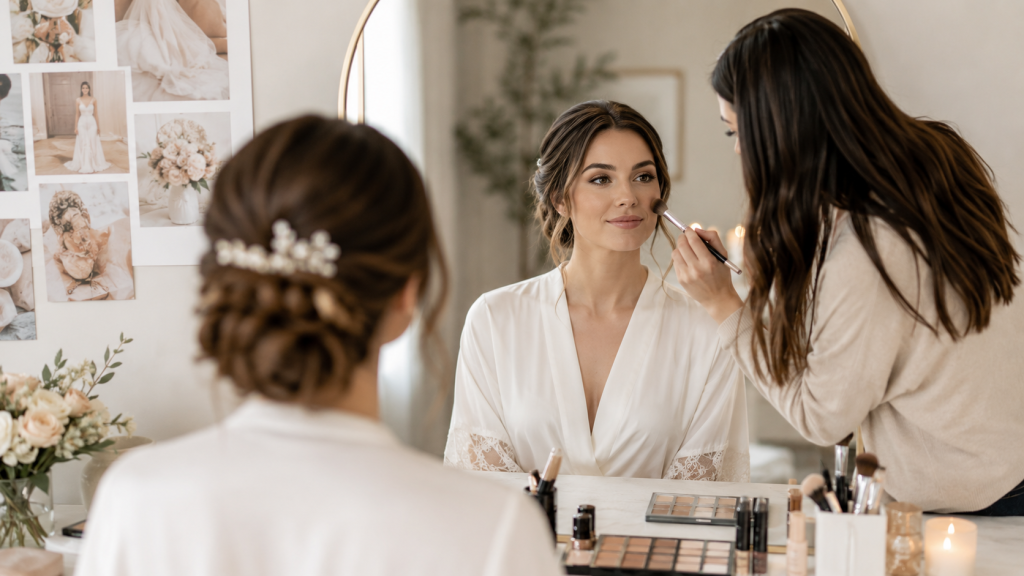
The makeup trial: why it is so important
The makeup trial is one of the most important stages in bridal preparation.
It should not be seen only as a quick test to see if the makeup looks nice. The trial is meant to build the look, understand preferences, adjust expectations, and ensure that the bride feels comfortable with the result.
During the trial, tones, intensity, skin finish, eye definition, lip color, and the overall balance of the makeup are tested.
It is also the ideal moment to talk.
The bride can explain the wedding style, show references, talk about the dress, hairstyle, accessories, ceremony location, time of day, and how she wants to feel.
This information helps create makeup that is more coherent with the overall look.
The trial also helps identify what the bride does not want.
Sometimes the bride knows she does not like heavy skin, very dark eyes, overly washed-out lips, or strongly defined brows. Saying what she dislikes is just as important as showing what she likes.
The goal of the trial is not to impose a look.
It is to find the balance between the bride’s vision and what works technically for her face and skin.
Whenever possible, the trial should take place when some elements are already defined: dress, planned hairstyle, accessories, and overall wedding style. This allows the makeup to be evaluated in a more realistic context.
It can also be helpful to wear a white, light-colored, or dress-adjacent tone outfit.
Clothing color influences how makeup is perceived. A look that seems more intense with a dark top may appear softer against white, ivory, or light tones.
During or after the trial, it is advisable to take photos.
The mirror shows one perception. The camera can show another. Taking photos in natural light, from different angles, and if possible under lighting similar to the wedding setting helps evaluate the result more accurately.
Makeup should look beautiful in person, but it also needs to work in images.
The trial also helps test comfort.
The bride can notice whether she likes the feel of the foundation, whether the eye makeup feels too heavy, whether the lipstick matches her expectations, or whether any detail needs adjusting.
This process prevents rushed decisions on the wedding day.
On the actual day, everything should be clearer. The bride knows what has been chosen. The makeup artist knows the skin, style, and preferences. The direction has already been defined.
The trial brings peace of mind.
And in a wedding, that peace of mind is invaluable.
How to choose a bridal makeup artist
Choosing a bridal makeup artist means choosing a professional who will be present during a very special and intimate part of the day.
For this reason, the decision should not be based only on price or a beautiful image seen on social media.
The portfolio is important, of course. But it is not the only criterion.
When reviewing a makeup artist’s work, it is useful to see whether there are different types of brides, faces, skin tones, ages, and styles. Good bridal makeup should not look the same on every woman. It should be adapted to the person.
It is also important to understand whether the artist’s style matches what the bride is looking for.
Some professionals focus more on natural and luminous looks. Others are stronger in glamorous or more defined makeup. Ideally, you should find a makeup artist whose portfolio clearly aligns with your desired result.
Experience with brides also makes a difference.
The wedding day has its own rhythm. There are schedules, emotions, photos, family, travel, and unexpected moments. A makeup artist experienced with brides knows how to stay calm, manage timing, prepare the skin for long wear, and handle the emotional atmosphere of the day.
Communication is another essential point.
From the first contact, there should be clarity: availability, pricing, trial, travel, schedules, number of people to be made up, booking conditions, and what is included.
Unclear communication can create insecurity.
The bride should feel free to ask questions, share concerns, and explain what she likes or dislikes. The makeup artist should listen, guide, and adapt, without imposing a style that does not suit the person.
Empathy also matters.
The wedding morning is sensitive. The bride may feel nervous, emotional, or more vulnerable. Having a calm, attentive, and confident professional helps a lot.
The makeup artist is not just applying products. They are contributing to how the bride feels before walking into the ceremony.
Therefore, before choosing, it is worth checking:
- whether the date is available;
- whether the portfolio style matches what you want;
- whether there is experience with brides;
- whether the trial is included or optional;
- where the trial takes place;
- whether travel to the preparation location is available;
- how long makeup takes on the day;
- whether other people can also be made up;
- what the payment conditions are;
- whether there is a contract or written confirmation;
- whether communication feels trustworthy.
The right makeup artist should combine technique, sensitivity, and organization.
She should make the bride feel heard, safe, and calm.
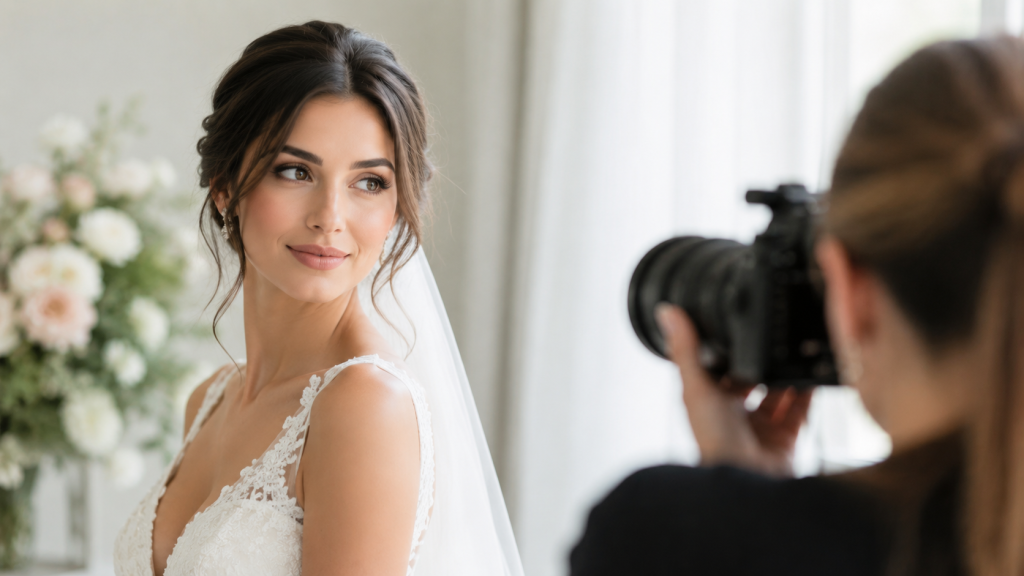
Makeup and photography: what changes?
Bridal makeup needs to work in real life, but also in photography and video.
This is one of the biggest challenges.
On the wedding day, the bride will be seen up close, but also photographed in many different environments: natural light, shade, indoors, flash, late afternoon, dance floor, and possibly video.
Each type of light can change how makeup is perceived.
Very luminous skin in the mirror may look oily in photographs. Skin that is too matte may look flat or lifeless. Poorly blended concealer can become more visible on camera. A slightly wrong foundation shade can create a mismatch between face, neck, and décolleté.
For this reason, makeup must be balanced.
The skin should be even, but not heavy. It should control shine in the right areas while maintaining natural luminosity. The face should have enough definition not to disappear in photos, but without looking artificial in person.
The camera can also soften some intensity.
A look that seems strong in the mirror may appear softer in photos. That is why, even in natural makeup, it may be necessary to add some definition to the eyes, brows, lashes, and lips.
This does not mean creating heavy makeup.
It means preparing the face for different ways of being seen.
Bridal makeup should look beautiful up close, elegant in person, and consistent in photography and video.
The choice of products also matters.
Products with too much shimmer or reflective particles should be used carefully, as they can react to light or flash. Powder should be applied in moderation to avoid emphasizing texture. Foundation must be well matched to the skin tone and undertone.
It is also important to consider the neck and décolleté, especially if the dress leaves them visible.
The face should not look separate from the rest of the skin. Harmony between face, neck, and chest is essential for natural-looking photographs.
That is why the makeup trial can be so useful.
Photographing the trial result helps understand how makeup appears on camera and whether any adjustments are needed. Sometimes it is enough to slightly enhance blush, soften contour, adjust lipstick, or better control shine.
Photography should not completely dictate makeup, but it should be considered.
After all, photos last.
And makeup should still make sense in them many years later.
Longevity: how to make makeup last all day
Bridal makeup needs to last.
The wedding day often starts early and ends many hours later. Between preparation, ceremony, photos, greetings, hugs, tears, dinner, dancing, and celebration, makeup goes through many different moments.
For this reason, longevity is an essential part of the result.
Beautiful makeup at the beginning of the day is not enough. It should remain elegant, comfortable, and balanced for as long as possible.
Longevity starts with skin preparation.
Clean, hydrated skin that is suited to the makeup type allows products to sit better. Dehydrated skin can emphasize texture. Oily skin can cause foundation to break down faster. Sensitized skin may react or feel uncomfortable.
Therefore, skin preparation must be considered both before and on the day itself.
But longevity does not mean using excessive product.
This is an important point. It is often assumed that long-lasting makeup must be heavier, with many layers and lots of powder. In reality, well-constructed makeup can last a long time without looking heavy.
The secret lies in technique, product selection, and layering balance.
Foundation should suit the skin type. Concealer should be used only where needed. Powder should control shine without removing natural glow. Setting should be strategic, not excessive.
Climate should also be considered.
In a summer wedding, outdoors or in a warm venue, it may be necessary to increase shine control and use more resistant products. In a winter wedding, more attention may be needed for hydration and skin comfort.
Skin type also plays a role.
Oily skin may require specific preparation, powder in the right areas, and small touch-ups during the day. Dry skin needs enough hydration so makeup does not cling or emphasize dry patches. Sensitive skin should be treated with well-tolerated products.
Eye makeup should also be designed for durability.
Tears, emotion, heat, and long wear can affect eyeshadow, pencil, or mascara. Long-wear and well-applied products help prevent smudging or transfer.
Lips are usually the area that requires the most touch-ups.
During the wedding, the bride talks, smiles, kisses, drinks, eats, and greets many people. It is natural for lipstick to need reapplication. That is why it is useful to carry the chosen lipstick or a similar product for touch-ups.
It can also be helpful to have blotting papers or compact powder to control shine, especially in the T-zone.
The goal of touch-ups is not to redo the makeup. It is simply to keep it looking fresh and polished.
Well-prepared bridal makeup should allow the bride to forget about it for most of the day.
She should feel secure, comfortable, and confident, without constantly worrying about her reflection.
The wedding morning
The wedding morning has a strong influence on how the day is experienced.
It is the moment everything begins: preparation, suppliers arriving, first photos, last-minute details, family emotions, makeup, hair, and the dress.
For this reason, it should be organized calmly.
Bridal makeup needs time. It should not be rushed between interruptions, phone calls, and last-minute decisions.
The ideal situation is a realistic timeline, with enough margin for makeup, hair, dressing, photos, and small unexpected delays.
The bride should be ready before the final deadline.
This means makeup and hair should not finish exactly at the moment she needs to dress or leave. There should be time to observe the result, make adjustments, add accessories, put on the dress, adjust the veil, take photos, and breathe.
The space also matters.
Whenever possible, preparation should take place in a location with good light, some calm, and enough space for makeup, hair, dress, and photography. A room that is too crowded, dark, or disorganized can make everything more difficult.
Natural light helps a lot, both for makeup and for getting ready photos.
It is also important to control the number of people present.
Having family and friends nearby can be very special, but too many people in the same space can create noise, opinions, questions, and anxiety. The bride should choose who she truly wants by her side in that moment.
Before the makeup artist arrives, the skin should be clean and comfortable.
There is no need to apply many products. In fact, heavy creams, oils, or new products can interfere with makeup. The ideal is to follow previously given instructions and avoid experimenting on the day itself.
The outfit worn during preparation should also be considered.
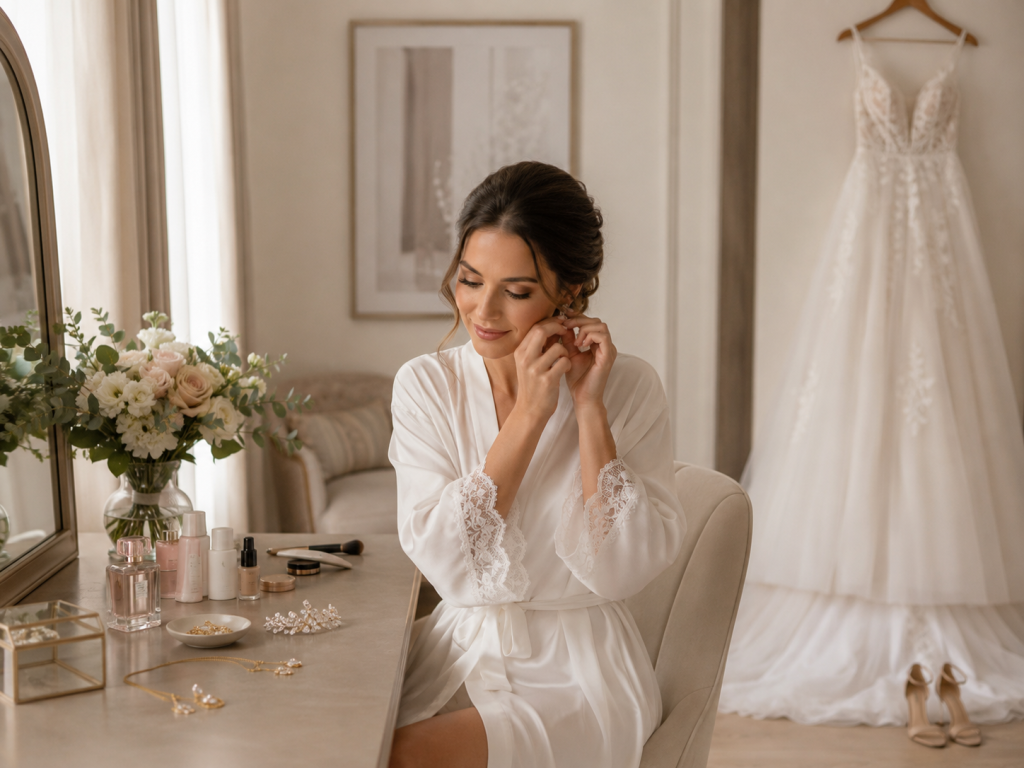
A robe, shirt, or front-opening garment helps avoid ruining makeup and hair when it is time to get dressed. This simple detail can prevent a lot of stress.
The accessories should be prepared.
The dress, veil, shoes, jewelry, perfume, lingerie, hair accessories, and bouquet should all be easily accessible, so no one needs to search for them in a hurry.
It is also useful to gather the details that will be photographed: invitation, rings, perfume, shoes, flowers, jewelry, or any special object.
The bride’s makeup should be integrated into the morning’s organization.
If other people are also getting their makeup done, such as the mother, bridesmaids, or family members, it is essential to define schedules and the order of preparation. The number of people has a major impact on the time needed.
A calm morning does not happen by chance.
It happens when there is preparation, time buffer, and the right people around.
What to avoid before bridal makeup
Just as important as knowing what to do is knowing what to avoid.
In the days before the wedding, some decisions can compromise skin comfort, makeup longevity, or the bride’s peace of mind.
The first rule is to avoid new products.
Even a very good product can cause a reaction if the skin is not used to it. Creams, serums, masks, exfoliants, or unknown treatments can cause redness, breakouts, burning, flaking, or sensitivity.
In the wedding week, the skin should only receive products that are already tested and well tolerated.
Aggressive exfoliation should also be avoided.
Overly strong exfoliation can leave the skin sensitized, uneven, or flaky. This can make foundation sit worse and emphasize texture.
Intensive skin treatments should also be planned in advance.
Peels, deep cleansing facials, laser, microneedling, or other procedures that may cause redness or peeling should not be done close to the date. Every skin reacts differently, and there may not be enough time to recover.
Self-tanner also requires caution.
If it has never been used before, it should not be tested for the first time near the wedding. It can cause streaks, uneven tone, transfer to the dress, or a stronger result than expected.
Another thing to avoid is completely changing the look on the wedding day.
The trial exists precisely to reduce uncertainty. Small adjustments are normal, but changing the entire makeup direction on the wedding morning can create insecurity and delays.
It is also important to avoid too many opinions.
Bridal makeup should make sense for the bride. Bringing too many people to the trial or allowing too many opinions on the day can make the decision confusing.
The most important opinion is the bride’s own.
Another decision to avoid is choosing makeup based only on trends.
Trends can inspire, but they do not suit every face or wedding. A look too strongly driven by trends may not feel timeless in photographs.
It is also important not to ignore skin type.
Oily, dry, sensitive, or dehydrated skin needs appropriate preparation and products. Using makeup that does not respect the skin can compromise comfort and longevity.
In the days before, the best approach is simple: maintain routine, hydrate, rest when possible, and avoid experiments.
The calmer the skin, the better the base for makeup.
Bridal makeup checklist
A checklist helps organize preparation and prevents important details from being forgotten.
It does not need to be followed with anxiety. It is simply a support tool to ensure the main details are defined before the day.
Before the wedding, confirm:
- wedding date;
- ceremony location;
- preparation location;
- ceremony time;
- time the bride needs to be ready;
- makeup artist arrival time;
- makeup start time;
- hair time schedule;
- time for putting on the dress;
- time for photos;
- number of people getting makeup done;
- order of preparation for each person;
- booked makeup trial;
- chosen makeup references;
- examples of makeup the bride does not like;
- photo of the dress;
- hairstyle style;
- main accessories;
- veil, jewelry, and hair details;
- information about skin type;
- allergies or sensitivities;
- usual skincare routine;
- products the skin does not tolerate;
- travel requirements;
- payment conditions;
- written contract or confirmation;
- lipstick for touch-ups;
- blotting paper or compact powder;
- tissues;
- person responsible for the emergency kit;
- appropriate getting-ready outfit;
- space with light and available sockets;
- important contacts for the day.
For the makeup trial, you can also confirm:
- whether inspiration images were brought;
- whether the wedding style was explained;
- whether the dress or references were shown;
- whether skin type was discussed;
- whether photos of the result were taken;
- whether the makeup was evaluated in natural light;
- whether the foundation felt comfortable;
- whether the eye intensity was right;
- whether the lipstick matched expectations;
- whether any adjustments are needed before the wedding day.
This checklist helps turn the preparation into a clearer process.
The fewer doubts left for the morning of the wedding, the calmer the experience will be.
Conclusion: the best bridal makeup is designed for you
The best bridal makeup is not the most subtle, the most dramatic, or the most trendy.
It is the one that makes sense for the bride.
Well-designed bridal makeup respects the face, skin, personal style, dress, location, light, photography, and the way the bride wants to feel.
It should enhance without transforming. Correct without weighing down. Illuminate without exaggerating. Last without causing discomfort.
Each bride has a different relationship with makeup. Some seek a very natural result. Others want more definition, sophistication, or presence. The important thing is that the choice is made with calm, listening, and intention.
Skin preparation, the makeup trial, choosing the makeup artist, planning the morning, and ensuring longevity are all part of the same process.
Everything contributes to the bride feeling more secure and relaxed on her big day.
Ideal bridal makeup does not begin at application.
It begins with choosing the look, conversations, inspiration, skin preparation, and the trial. It begins with building trust between the bride and the professional who will accompany her.
On the wedding day, makeup should allow the bride to live the moment.
To smile, cry, hug, dance, greet guests, and be photographed without constantly worrying about the mirror.
When makeup is designed for the real bride, the result is more natural, more elegant, and more authentic.
And that is what makes the difference.
Frequently asked questions about bridal makeup
When should I book my bridal makeup artist?
The ideal time is as soon as you have your wedding date, venue, and main schedule confirmed.
Bridal makeup artists can get fully booked well in advance, especially during peak wedding season. Booking early helps secure the date, organise the trial, and plan the look more calmly.
Is a makeup trial mandatory?
No, but it is highly recommended.
The trial allows you to test the look, adjust intensity, choose shades, understand skin finish, and ensure you feel comfortable with the result.
It also helps avoid rushed decisions on the wedding day.
When should I do my makeup trial?
Whenever possible, the trial should be done once key elements are already defined, such as the dress, accessories, hairstyle, and overall wedding style.
This ensures the makeup is designed in harmony with the full look.
What should I bring to my makeup trial?
You should bring inspiration images, examples of looks you dislike, a photo of your dress, hairstyle ideas, key accessories, and information about your skin type.
It is also important to share allergies, sensitivities, or products you usually avoid.
How should I prepare my skin before makeup?
Preparation should be simple and consistent.
Gentle cleansing, proper hydration, and daily sun protection are good starting points. Closer to the wedding date, you should avoid new products, aggressive treatments, and last-minute experiments.
The skin should arrive at the wedding calm, hydrated, and comfortable.
Does natural bridal makeup last all day?
Yes, as long as it is properly prepared and adapted to the skin type.
Natural does not mean fragile or unskilled. Natural bridal makeup can be built with suitable products, correct preparation, and strategic setting to last for many hours.
Should bridal makeup be stronger for photography?
It may need some extra definition.
Cameras, lighting, and flash can soften makeup. Therefore, even in a natural look, it may be important to define eyes, brows, lashes, and lips so the face remains present in photos and video.
The goal remains naturalness, but with balance.
What should I avoid in the week before the wedding?
You should avoid new products, aggressive treatments, strong exfoliation, untested self-tanner, drastic hair or skin changes, and major changes to the look chosen at the trial.
The week of the wedding should be a period of stability, not experimentation.
What should I bring for touch-ups on the day?
Usually, it is helpful to bring your chosen lipstick or a similar shade, blotting papers or compact powder, tissues, and, if needed, cotton buds.
Professional makeup should last well, but lips and shine control may require small touch-ups during the day.
How do I choose between natural and glamorous makeup?
The choice should depend on your personal style, dress, venue, wedding time, and how you want to feel.
If you rarely wear makeup, a very intense look may feel uncomfortable. If you normally wear more defined makeup, something too subtle may feel insufficient.
The best look is the one that enhances you and makes you feel confident.
Are you preparing your wedding?
Bridal makeup should be planned with time, care, and attention to detail, from the trial to the wedding morning.
Filipa Villar Afonso creates personalised bridal makeup looks tailored to your face, skin, wedding style, and how you want to feel on your day.
If you are preparing your wedding, you can explore the bridal makeup service and send your wedding details to receive a personalised proposal.