Starting to do makeup can seem more complicated than it really is.
There are many products, many techniques, many tutorials and many different opinions. In a quick search, it’s easy to find routines with ten or fifteen steps, various brushes, foundations, concealers, powders, bronzers, highlighters, eyeshadows, eyeliners and products that all seem essential.
But for those who are just starting out, makeup doesn’t need to be like that.
A good self-makeup routine should be simple, practical, and adapted to the face, skin type, and daily life of each person. The goal is not to copy makeup seen on social media, nor to completely transform the face. The goal is to learn how to enhance features, correct small areas if it makes sense, and create a more polished, comfortable and natural look.
Self-makeup starts with just a few well-executed steps.
A prepared skin, a light foundation or well-applied concealer, a bit of blush, mascara and a simple lip product can be enough to create a beautiful and easy-to-repeat makeup look.
With time, other techniques can be added: eyebrows, eyeshadow, bronzer, highlighter, eyeliner or more defined lips. But there is no need to learn everything at once.
In this guide, I explain how to create a simple self-makeup routine for beginners, which products are really necessary at the beginning and which common mistakes to avoid.
Before you start: makeup doesn’t need to be complicated
One of the biggest difficulties for people starting to do makeup is the feeling that you need to know everything.
- Knowing how to choose the perfect foundation.
- Knowing how to apply concealer without creasing.
- Knowing how to do eyeliner.
- Knowing how to contour the face.
- Knowing how to choose brushes.
- Knowing how to blend eyeshadow.
- Knowing how to use highlighter.
- Knowing how to set everything so it lasts all day.
But the truth is that nobody needs to start there.
Makeup is learned step by step.
Like any other technique, it’s easier to build confidence when you start with the essentials. First, understand the skin. Then learn how to even it out without exaggerating. Next, bring color back to the face. Later, define eyes, eyebrows and lips with more intention.
Starting with too many products can make the process confusing. Instead of helping, it can create frustration.
Many people buy several products because they saw them recommended on social media, but then they don’t know the order to use them in, the right amount, or whether they actually work for their skin type.
The result can be makeup that looks heavy, unnatural or uncomfortable.
That’s why the best approach for beginners is to simplify.
You don’t need a large collection of products. You don’t need to use every step every day. You don’t need to follow trends that don’t make sense for your face or routine.
Simple makeup can be very beautiful.
It can make the skin look more even, the eyes more awake, the face fresher and the lips more cared for. And often, this result is more elegant than heavy makeup.
It’s also important to understand that makeup should adapt to the person, not the other way around.
A routine for someone who works outside every day can be different from a routine for someone who only wears makeup on special occasions. Oily skin may need different care than dry skin. Someone who prefers a very natural result may not feel comfortable with more intense products.
There is no single correct way to do makeup.
There is what works best for each face, each skin and each lifestyle.
For beginners, the most important thing is to gain practice with a simple and repeatable routine. Once that routine becomes easy, it becomes natural to add new products or techniques.
Self-makeup should bring confidence, not pressure.
Prepare the skin before makeup
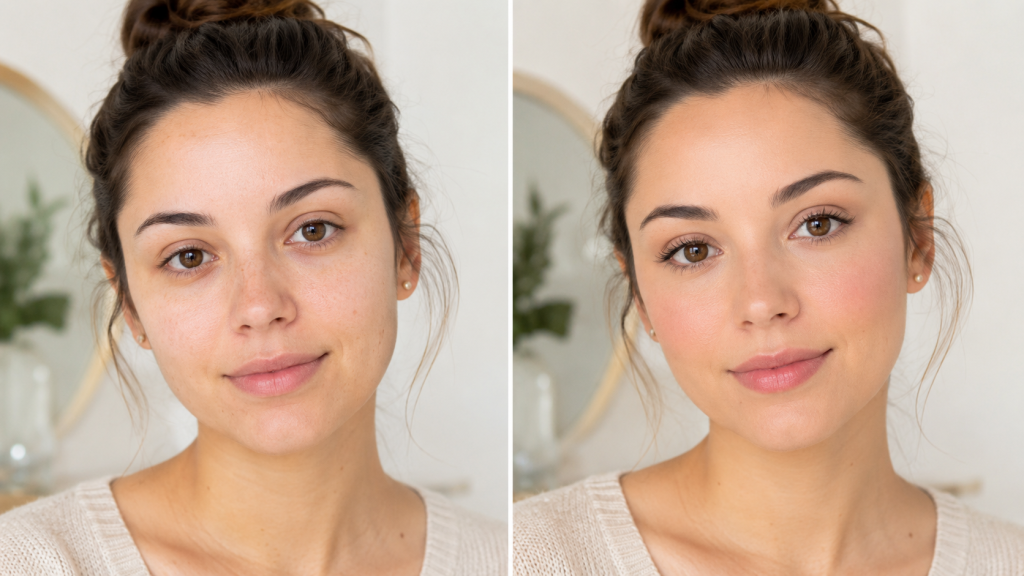
A beautiful makeup always starts with the skin.
This does not mean the skin has to be perfect. Real skin has texture, pores, small marks, dry areas, shine, redness or dark circles. All of this is normal.
Preparing the skin is not about turning it into a texture-free skin. It’s about making it more comfortable, balanced and ready to receive products.
When the skin is well prepared, makeup tends to apply better. Foundation spreads more easily, concealer creases less, the finish looks more natural and makeup can last longer.
The first step is cleansing.
The skin should be clean before makeup, but not stripped. A too harsh cleansing can leave the skin tight, sensitive or dry. The ideal is to use a gentle product suitable for your skin type.
Then comes moisturising.
Many people skip this step, especially those with oily skin, but moisturising is important for almost all skin types. Oily skin can also be dehydrated. When hydration is lacking, makeup may sit poorly, emphasise texture or even cause the skin to produce more oil during the day.
The secret is choosing the right texture.
Dry skin may need richer moisturisers. Oily skin may prefer lightweight, gel-based or oil-free textures. Sensitive skin should use simple, gentle and already tested products.
During the day, sunscreen is also essential.
Sunscreen should be part of the routine before makeup, especially when there is exposure to natural light. Ideally, choose a formula that works well with makeup, without pilling, heaviness or excessive shine.
Primer can be useful, but it is not mandatory.
There are primers that control shine, others that add hydration, others that smooth texture or increase longevity. But for beginners, there is no need to start with this step. Often, well-cleansed and moisturised skin is already enough for a simple everyday makeup look.
It is also important to wait a few minutes between skincare and makeup.
If you apply foundation right after moisturiser or sunscreen, products may mix too much, pill or lose adhesion. Giving the skin some time helps create a more stable base.
The skincare preparation should be simple:
- cleanse;
- moisturise;
- apply sunscreen during the day;
- wait a few minutes;
- start makeup with a small amount of product.
When the skin feels comfortable, makeup looks better.
And for beginners, that makes a big difference.
Essential products to start
A beginner makeup routine does not need many products.
In fact, starting with a few well-chosen products is usually better than buying many things at once.
The initial goal should be to create a simple, easy-to-repeat makeup look adapted to daily life. Later, with more practice, other products can be added as needed.
Essentials
Moisturiser
The moisturiser prepares the skin and helps makeup apply better.
It should be chosen according to skin type. Dry skin may need a richer texture. Oily skin may prefer something light. Sensitive skin should choose gentle and comfortable formulas.
Sunscreen
During the day, sunscreen is an important step.
It should be applied before makeup and ideally have a texture compatible with the products used afterwards. If it is too heavy or oily, it may interfere with foundation.
Light foundation, BB cream or skin tint
For beginners, a light foundation, BB cream or skin tint can be a good choice.
These products help even out the skin tone without creating a heavy layer. They are easier to apply, look more natural, and allow you to correct only what is necessary.
Not everyone needs foundation every day. In some cases, it may be enough to use concealer only on specific areas.
Concealer
Concealer is used to correct dark circles, small redness, spots or localized imperfections.
It should be used in small amounts. A common mistake is applying too much concealer, which can emphasize fine lines or make the under-eye area look heavy.
Blush
Blush is one of the products that most quickly changes the appearance of the face.
After foundation or concealer, the skin can look more even but may lose some natural color. Blush restores freshness, health and life to the face.
For beginners, pink, peach or soft mauve tones are usually easy to use.
Mascara
Mascara helps open up the eyes and gives more expression to the face.
Even in a very simple makeup look, it can make a big difference. For everyday use, a mascara that lengthens and defines without clumping is usually a good option.
Eyebrow product, if needed
Not everyone needs to fill in their eyebrows.
But when there are small gaps or a lack of definition, a pencil, powder or eyebrow gel can help frame the face.
The ideal is to fill them in gently, respecting the natural shape.
Lipstick, gloss or tinted balm
Lips complete the makeup look.
For beginners, a tinted lip balm, gloss or natural-toned lipstick is a practical and easy-to-apply option. Nude, pink, mauve or peach tones usually work well for everyday wear.
Pressed or translucent powder
Powder is not necessary for everyone, but it can be useful for skin that tends to get shiny.
It should be applied in moderation, especially on the T-zone: forehead, nose and chin. The goal is to control shine, not remove all the skin’s natural glow.
Optional products
After mastering a basic routine, it may make sense to add other products.
Primer
It can help with longevity, shine control or hydration, but it is not essential for beginners.
Bronzer
Bronzer warms up the face and adds dimension. It can be useful, but should be applied lightly.
Highlighter
Highlighter creates points of light on the face. It should be used carefully, especially on skin with texture or natural shine.
Eyeshadow
Neutral eyeshadows can help define the eyes, but they are not required in an initial routine.
Eyeliner
Eyeliner requires some practice. For beginners, it may be better to start with a brown pencil or softly blended eyeshadow close to the lash line.
Lip liner
It helps define the lips and increase lipstick longevity, but it is optional.
Setting spray
It can help for events or long days, but it is not essential for a simple routine.
Contour palette
Contouring can be interesting, but it should not be a priority for beginners.
For an initial routine, the most important thing is learning to work the skin well, use little product, and create balance.
Less products, well applied, usually give a more beautiful result than many products used without confidence.
Basic makeup tools
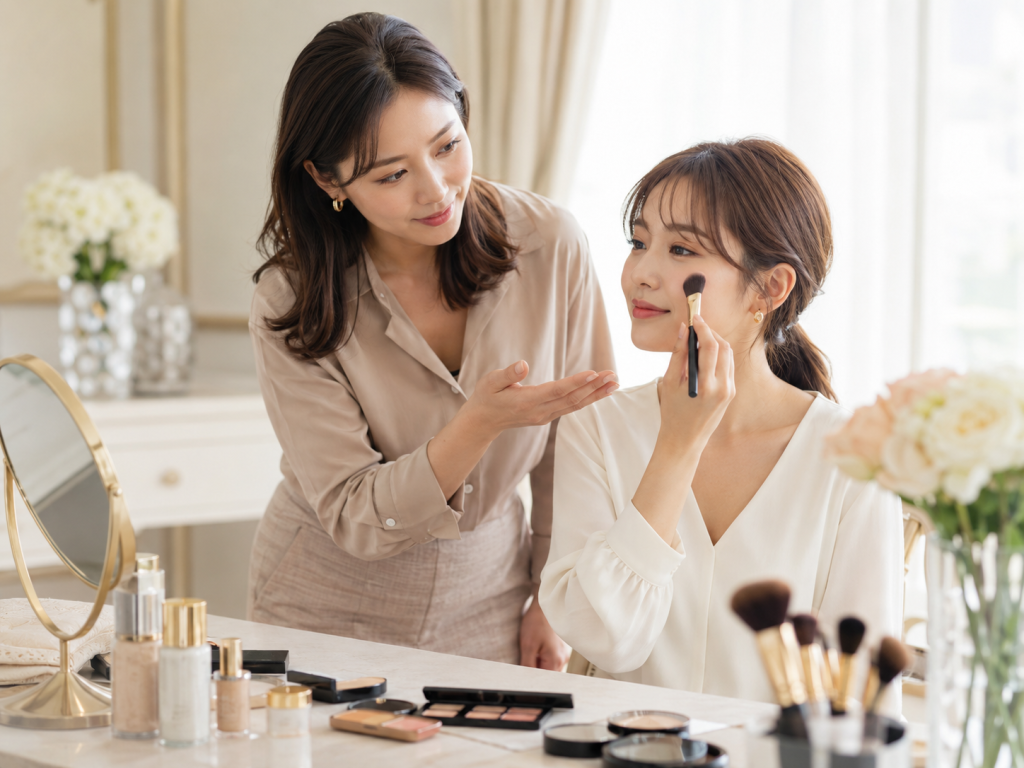
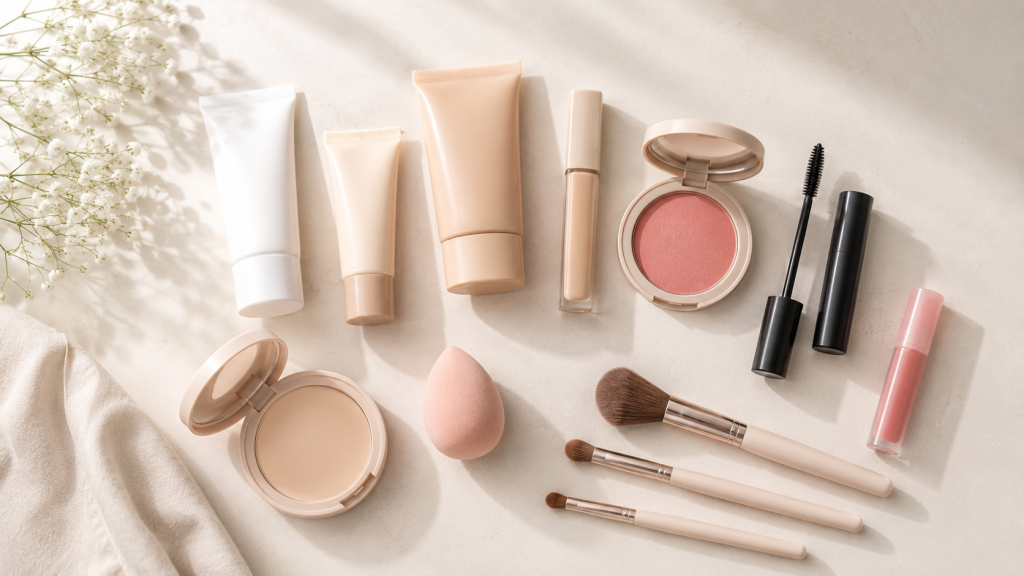
Besides products, some tools can make application much easier.
But again, there is no need to buy a huge brush set.
To start, only a few well-chosen tools are enough.
Makeup sponge
The sponge helps apply foundation and concealer in a lighter, more natural way.
It should be used slightly damp so it does not absorb too much product and helps blend makeup into the skin.
It is a good option for those who want a softer finish.
Powder brush
A powder brush allows a light application of pressed or translucent powder.
The ideal is not to overload the brush. Apply only a small amount of product where shine needs to be controlled.
Blush brush
The blush brush should allow a soft and well-blended application.
Blush should look integrated into the skin, not like a harsh patch. That’s why it is better to start with little product and build up if needed.
Eyeshadow brush
For those who want to use eyeshadow, one simple application brush and one blending brush may be enough.
Blending is more important than the amount of eyeshadow. A well-blended neutral shade looks better than multiple colors without transition.
Eyebrow spoolie
A spoolie helps comb the eyebrow hairs and see where there are gaps.
Even without product, brushing the eyebrows already gives a more polished look.
Cotton swabs
Cotton swabs are very useful for correcting small mistakes.
They can help clean mascara, soften pencil, fix lipstick or adjust eyeshadow.
Fingers can also be used
Not everything needs a brush.
Cream products, such as some blushes, eyeshadows or tinted moisturisers, can be applied with fingers. The warmth of the hands helps melt the product into the skin.
For beginners, this can make makeup simpler and more intuitive.
Tool hygiene
This point is very important.
Brushes and sponges collect product, oil and impurities. If not cleaned regularly, they can affect makeup application and even contribute to irritation or breakouts.
Sponges should be washed frequently and left to dry properly. Brushes should also be cleaned regularly, especially those used with liquid or cream products.
Clean tools help makeup look better and keep the skin healthier.
To start, a good basic set of tools can be:
- a sponge;
- a powder brush;
- a blush brush;
- a eyeshadow brush;
- a eyebrow spoolie;
- cotton swabs for corrections.
With these tools, it is already possible to create a simple, natural and practical routine.
Technique improves with repetition.
And in self-makeup, practicing a simple routine is almost always the best way to build confidence.
The simple order of makeup
These products help to even out the skin tone without creating a heavy layer. They are easier to apply, more natural, and allow you to correct only what is necessary.
Not everyone needs foundation every day. In some cases, it may be enough to use concealer only on specific areas.
Concealer
Concealer is used to correct dark circles, small redness, blemishes or localized imperfections.
It should be used sparingly. A common mistake is applying too much concealer, which can emphasize fine lines or make the under-eye area look heavy.
Blush
Blush is one of the products that most quickly changes the appearance of the face.
After foundation or concealer, the skin may look more even but also lose some of its natural color. Blush brings freshness, health, and life back to the face.
For beginners, soft pink, peach, or mauve tones are usually easy to use.
Mascara
Mascara helps open up the eyes and gives the face more expression.
Even in a very simple makeup look, it can make a big difference. For everyday use, a mascara that lengthens and defines without clumping is usually a good option.
Eyebrow product, if needed
Not everyone needs to fill in their eyebrows.
But when there are small gaps or little definition, a brow pencil, powder, or gel can help frame the face.
The ideal is to fill them in softly, respecting the natural shape.
Lipstick, gloss, or tinted lip balm
Lips complete the makeup look.
For beginners, a tinted lip balm, gloss, or natural-toned lipstick is a practical and easy option. Nude, pink, mauve, or peach tones usually work well for everyday makeup.
Pressed or translucent powder
Powder is not essential for everyone, but it can be useful for oily skin.
It should be applied sparingly, especially in the T-zone: forehead, nose, and chin. The goal is to control shine, not remove all the skin’s natural glow.
Optional products
After mastering a basic routine, it may make sense to add other products.
Primer
It can help with longevity, oil control, or hydration, but it is not essential for beginners.
Bronzer
Bronzer warms up the face and adds dimension. It can be useful, but it should be applied lightly.
It is not the same as contouring. Contouring creates shadow and definition. Bronzer gives a warmer look, as if the skin has naturally caught the sun.
It should be applied lightly to the areas where the sun would naturally hit: the sides of the forehead, cheekbones and, if it makes sense, a little on the nose.
For beginners, bronzer should be soft and well blended.
A tone that is too orange or too dark can look artificial.
Highlighter
Highlighter creates points of light.
It can be applied to the top of the cheekbones, inner corners of the eyes, the brow bone or the cupid’s bow. However, it should be used carefully, especially on skin with a lot of texture or a tendency to shine.
A subtle highlighter can add freshness. A very intense highlighter can emphasise texture or look excessive for everyday wear.
For beginners, blush is the most important product of these three.
Over time, you can add bronzer or highlighter, if it fits the desired style.
Cream products can be easier for a natural result, because they blend well into the skin. Powder products can be more practical for oily skin or when longer wear is desired.
The secret is to use little product and blend well.
Simple eye makeup for everyday wear
Eye makeup does not need to be complicated.
For everyday wear, often mascara alone is enough to make a difference. It opens up the eyes, adds definition and makes the face look more awake.
If you want to add eyeshadow, start with neutral tones.
Beige, soft brown, taupe, champagne, soft pink or subtle bronze are easy-to-use shades that match many styles.
A light shade on the eyelid can brighten the eyes. A slightly darker shade in the crease can add depth. The most important thing is to blend well to avoid harsh lines.
For beginners, it is better to start with one or two eyeshadows, not a full palette of colours.
Eyeliner is not essential.
Many people struggle with liquid eyeliner, and that is normal. Instead of starting with a very defined line, you can use a brown pencil or a dark eyeshadow close to the lash line and softly blend it out. The result looks more natural and is easier to correct.
Mascara should be applied calmly.
Start at the base of the lashes and move upwards in gentle strokes. One coat may be enough for everyday wear. If you want more definition, apply a second coat before the first one fully dries.
If you smudge the eyelid, you do not need to start over.
Wait for it to dry and remove it with a cotton bud. If you try to clean it while it is still wet, you may spread it further.
In eye makeup, the rule for beginners is simple: less intensity, more blending.
A soft, well-defined eye look is usually easier to wear and more elegant than heavy makeup without technique.
Eyebrows: defining without hardening the face
Eyebrows have a big impact on the face.
They frame the eyes, balance expression and can make makeup look more polished, even when everything else is very simple.
But for beginners, the goal should not be to draw a completely new eyebrow shape.
The ideal is to respect the natural shape and fill only where necessary.
The first step is to brush the eyebrows.
This alone already helps to see the shape, gaps and hair direction. Then, if there are sparse areas, you can use pencil, powder or tinted gel.
Application should be light.
Instead of drawing a continuous line, it is better to mimic small hairs, filling only the gaps. The front of the eyebrow should remain softer to avoid a heavy or artificial effect.
A clear gel can also be enough for those who already have full eyebrows but want to keep them in place.
The product colour should be chosen carefully.
A shade that is too dark can harden the face. It is usually safer to choose a shade close to the natural hair colour or slightly softer.
Very bold eyebrows can age the expression or make makeup look heavier.
The goal is definition, not heaviness.
When eyebrows are well brushed and lightly filled, the face looks more harmonious without appearing overly made up.
Easy lip makeup for beginners
Lips are an easy way to complete a makeup look.
For beginners, it is best to start with products that are easy to apply and comfortable to wear.
A tinted lip balm is an excellent everyday option. It hydrates, adds a bit of colour and does not require much precision.
Gloss can also be practical, especially when you want a fresh and luminous result. However, it can transfer more easily and require touch-ups.
Nude, pink, mauve or peach lipsticks are usually good choices to start with. They are easier to apply than very dark or very bold shades and allow small mistakes without being too noticeable.
Before applying lipstick, it is important to hydrate the lips.
Dry lips or flaking skin can make lipstick apply unevenly. A simple lip balm used regularly already helps a lot.
Lip liner is optional.
It can help define the lip contour and increase lipstick longevity, but it is not necessary in an early routine. If you want to try it, it is best to choose a shade close to your natural lip colour or the lipstick used.
Very dark or intense red tones require more precision and maintenance.
They can be very beautiful, but may not be the easiest choice for beginners or for a quick everyday routine.
A good way to apply lipstick naturally is to place a little in the centre of the lips and blend it out with your finger. The result looks softer and less defined.
To start with, lips should be simple, comfortable and easy to touch up.
Makeup should fit into your routine, not create extra worry.
Common mistakes in beginner self-makeup
When you start learning self-makeup, it is normal to make some mistakes.
It is part of the process. Makeup is a practical skill, and confidence only comes from experimenting, repeating and adjusting.
Still, there are some very common mistakes that can be avoided from the start. Fixing these points helps achieve a more natural, comfortable and easy-to-wear everyday makeup look.
Using too much foundation
One of the most frequent mistakes is applying too much foundation.
Many people try to cover everything with foundation: dark circles, pimples, spots, redness and texture. The problem is that when there is too much product all over the face, the makeup can look heavy, settle into lines and create a mask-like effect.
Foundation should even out the skin, not hide it completely.
For a more natural result, it is better to apply a thin layer of foundation or BB cream and use concealer only in the areas that need more coverage.
Real skin has texture, pores and small marks. Makeup does not need to erase everything to look beautiful.
Choosing the wrong foundation shade
Another very common mistake is choosing a foundation that is too light, too dark, too yellow, too pink or too orange.
This often happens because the foundation is tested on the hand, in the wrong light, or chosen only by the packaging.
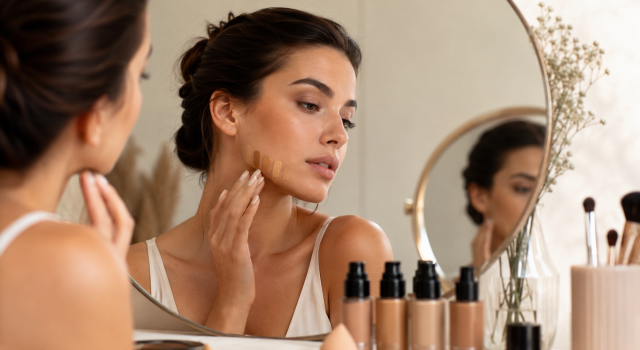
The ideal is to test foundation on the jawline, comparing it with the neck. Whenever possible, it should be checked in natural light.
The right foundation should disappear into the skin. It should not create a visible line between face and neck, nor significantly change the natural tone.
It is also important to remember that foundation should not be used to bronze the face. To add colour, there are other products such as blush and bronzer.
Applying too much powder
Powder can be very useful for controlling shine and setting products, but it should be used in moderation.
When over-applied, it can make the skin look too dry, heavy or lifeless. It can also emphasise texture, fine lines and dehydrated areas.
Not everyone needs powder all over the face.
Oily skin types may apply it to the T-zone: forehead, nose and chin. Dry skin types may need very little powder or only in specific areas.
The goal is to control shine, not remove the skin’s natural glow.
Not preparing the skin
Skipping skincare preparation is another very common mistake.
When the skin is not clean, hydrated or comfortable, makeup may sit poorly. Foundation can cling to dry areas, concealer can crease, and the result can look less natural.
Preparation does not need to be complicated.
A gentle cleanse, proper hydration and sunscreen during the day already make a big difference.
Makeup looks better when the skin is balanced.
Not blending properly
Blending is one of the most important parts of makeup.
Harsh lines from foundation, concealer, blush, bronzer, eyeshadow or pencil make the result look less natural.
For beginners, it is better to use little product and blend slowly. It is always easier to add than to remove.
Blush should melt into the skin. Eyeshadow should have soft transitions. Foundation should be well blended along the jawline, nose and hairline.
When products are well blended, makeup looks lighter and more elegant.
Copying overly advanced tutorials
Social media can be a good source of inspiration, but it can also create a lot of confusion.
Many tutorials are designed for video, photography, artificial lighting or more intense makeup looks. They do not always work for everyday life, natural light, or for someone who is just starting out.
Techniques such as heavy contouring, baking, graphic eyeliner, very dark eyes or multiple layers of products can be beautiful in certain contexts, but they are not essential in a simple routine.
For beginners, the best approach is to first learn an easy, natural and repeatable makeup look.
Then, with more practice, it becomes easier to try new techniques.
Buying products before understanding your routine
Another common mistake is buying too many products before really knowing what you need.
A person may buy bronzer, highlighter, multiple foundations, eyeshadow palettes, primers, setting sprays and brushes, but still not know how to create a simple makeup look.
Before buying more, it is worth understanding:
- what skin type you have;
- how much time you want to spend on makeup;
- what result you prefer;
- what products you already use;
- what difficulties you experience;
- which steps are actually important for your routine.
Starting with a few well-chosen products is almost always better than buying too much and not knowing where to begin.
5-minute simple routine
A quick makeup look can be enough for everyday life.
There is not always time, patience or need for a full routine. For many people, five minutes is enough to create a more polished, fresh and natural look.
The key is to choose a few products and apply them in a simple way.
1. Hydrate the skin
Start with clean skin and apply a suitable moisturizer.
During the day, sunscreen should go on before makeup. If your sunscreen already has a comfortable texture, it can even replace moisturizer in some routines, depending on the skin.
The skin does not need to be perfect. It needs to feel comfortable.
2. Even out only where needed
Instead of applying foundation all over the face, you can use a BB cream, skin tint or concealer only in the areas that need it.
For example: redness around the nose, dark circles, small marks or spots.
This approach is quick and leaves the skin looking more natural.
3. Apply blush
Blush is one of the most important steps in a short routine.
It brings life to the face, adds freshness and makes the makeup look more complete.
It can be applied to the cheeks and blended softly. If it is a cream blush, it can be applied with the fingers.
4. Mascara
One coat of mascara helps open up the eyes.
It does not need to be very intense. The goal is to add definition and make the face look more awake.
5. Simple lips
Finish with a tinted lip balm, gloss or natural lipstick.
A product that is easy to reapply throughout the day is ideal for a quick routine.
5-minute routine example
- Moisturizer or sunscreen;
- concealer on specific areas;
- blush;
- mascara;
- tinted lip balm or gloss.
This routine is simple, practical and easy to repeat.
It is a good foundation for anyone who wants to start without overcomplicating things.
15-minute full routine
When there is more time, it is possible to build a more complete makeup look, while still keeping it simple and natural.
A 15-minute routine can work for work, meetings, lunches, casual events or days when you want a more polished appearance.
1. Prepare the skin
Start with cleansing, moisturizing and sunscreen during the day.
Wait a few minutes before applying foundation so the products can settle better.
2. Apply light foundation
Use a light foundation, BB cream or skin tint to even out the face.
Apply a small amount and blend well. The goal is to improve the skin, not to fully cover it.
3. Correct specific areas
Apply concealer where needed: dark circles, redness, spots or small imperfections.
Use a small amount and blend the edges well.
4. Set only where needed
Apply powder to the T-zone or areas where makeup tends to wear off faster.
Avoid using too much powder on drier areas.
5. Add colour back to the face
Apply blush for freshness.
If you want, you can add bronzer to gently warm up the face. Highlighter is optional and should be used sparingly.
6. Define eyebrows
Brush the eyebrows.
If needed, fill small gaps with pencil, powder or gel. Keep the result soft and natural.
7. Eye makeup
Use a neutral eyeshadow on the lid or crease to add definition.
Soft brown, taupe, beige, pink or champagne shades are easy to use.
If you want more lash definition, use a brown pencil or smudged dark shadow close to the lash line.
Finish with mascara.
8. Lips
Choose a comfortable lipstick, gloss or tinted lip balm.
For a simple routine, natural tones are easier to maintain throughout the day.
9. Final setting
If the makeup needs to last several hours, you can finish with a setting spray or carry touch-up products such as lipstick and compact powder.
15-minute routine example
- Skin preparation;
- light foundation;
- concealer;
- powder in T-zone;
- blush;
- optional bronzer;
- eyebrows;
- neutral eyeshadow;
- mascara;
- lips;
- optional setting spray.
This routine allows for a more complete look without feeling too heavy.
The important thing is to keep application light and well blended.
How to progress without overcomplicating things
After learning a simple routine, it is natural to want to try more.
Maybe learning eyeliner, using eyeshadow, choosing foundation better, applying bronzer, correcting dark circles or creating a more event-ready makeup look.
Progress should be gradual.
There is no need to change everything at once. In fact, trying to learn too many techniques at the same time can lead to frustration.
The ideal approach is to focus on one thing at a time.
For example, for a few weeks, focus only on applying foundation better. Then try different ways of applying blush. Later, learn to fill in eyebrows. Then test neutral eyeshadows.
This approach makes learning lighter and more effective.
It also helps to repeat the same routine several times.
Makeup improves a lot with repetition. The more you repeat, the more you understand the right amount of product, the best brush, the best placement for blush, the shade that suits you best, and how the skin behaves throughout the day.
Another useful rule is to introduce only one new thing at a time.
If you buy a new foundation, do not also use a new moisturizer, a new primer and a new powder on the same day. If something does not work, it becomes hard to understand why.
The same applies to techniques.
If you are learning eyeliner, you do not need to pair it with a very complex base and intense eyeshadow. The simpler everything else is, the easier it will be to focus on that one technique.
It is also important to adapt makeup to your real face.
Not all techniques seen in videos work on every face. Eye shape, skin texture, age, personal taste and daily routine all strongly influence the result.
Self-makeup should not be a copy.
It should be an adaptation.
This is where self-makeup lessons can be very useful. Instead of following generic tutorials, you learn on your own face, with your own products, your own skin type and your real doubts.
Often, small adjustments make a big difference: changing blush placement, using less concealer, choosing a different foundation shade, softening the brows or applying mascara in a different way.
Progressing in makeup does not mean making it more complicated.
It means learning to do better what already makes sense for you.
Self-makeup beginner checklist
Before starting, this checklist can help organise your routine.
You do not need to have everything perfect. The goal is to understand whether you have a simple, practical and suitable base.
Check:
- you know your skin type;
- you prepare your skin before makeup;
- you use proper hydration;
- you apply sunscreen during the day;
- you have chosen a light foundation or comfortable base product;
- you test foundation on the jawline and in natural light;
- you use concealer only where needed;
- you apply small amounts of product;
- you blend foundation, concealer, blush and eyeshadow well;
- you use powder only where necessary;
- you have blush to bring colour back to the face;
- you use mascara to open up the eyes;
- you gently brush or define your eyebrows;
- you choose easy-to-apply lip products;
- you do not try to copy overly advanced techniques at the beginning;
- you practice a simple routine before adding new steps;
- you clean brushes and sponges regularly;
- you observe how makeup behaves throughout the day;
- you adapt your routine to your face, skin and lifestyle.
This checklist is meant as guidance.
Self-makeup should not be a strict list of rules. It should be a process of discovery.
With practice, it becomes easier to understand what works, what is not necessary and what can be improved.
Conclusion: starting simple is the best path
Beginner self-makeup does not need to be complicated.
You do not need to buy many products, follow every social media trend or master advanced techniques right away.
The most important thing is to start with the essentials: prepare the skin, choose a few suitable products, use small amounts and blend well.
A simple routine can be enough to create a polished, natural and comfortable look.
Over time, practice builds confidence. You start to better understand your face, your skin type, the shades that suit you, the products that work for you and the steps that make sense in your routine.
Makeup should help, not pressure you.
It should enhance, not hide. It should adapt to the person, not force the person to adapt to rigid rules.
Starting simple is the best path because it allows you to learn calmly, avoid unnecessary purchases and build a routine that is genuinely useful in everyday life.
Then, once the basics are solid, it becomes easier to experiment, evolve and add new techniques.
Self-makeup is, above all, a way of getting to know your own face better.
And that process should be light, practical and enjoyable.
Frequently asked questions about beginner self-makeup
What products do I need to start doing makeup?
To start, you only need a few products.
A simple routine may include moisturizer, sunscreen, light foundation or BB cream, concealer, blush, mascara and an easy lip product such as tinted balm, gloss or natural lipstick.
If your skin tends to get shiny, you can add a compact or translucent powder.
Do I need to wear foundation every day?
No.
Foundation is optional. If you prefer a lighter makeup look, you can use only concealer on the areas you want to correct, such as dark circles, redness or small marks.
You can also choose BB cream, skin tint or tinted moisturizer.
The important thing is to feel comfortable with the result.
Is primer necessary?
No.
Primer can help in some situations, such as oily skin, visible texture, long events or makeup that needs to last longer. But it is not necessary for a simple routine.
For many people, well-cleansed and hydrated skin is enough.
How do I choose the right foundation shade?
The ideal is to test foundation on the jawline, comparing it to the neck.
Whenever possible, check it in natural light and wait a few minutes to see if it oxidises or changes tone.
The right foundation should disappear into the skin and create harmony between face and neck.
What is the most common beginner mistake?
One of the most common mistakes is using too much product, especially foundation, concealer and powder.
Starting with a small amount usually gives a more natural result. If needed, you can build coverage gradually.
Another common mistake is not blending properly.
How can I do quick everyday makeup?
A quick makeup look can include moisturiser, concealer or light foundation, blush, mascara and tinted lip balm.
With these steps, you can create a polished look in just a few minutes.
Should I use blush, bronzer and highlighter every day?
No.
For a basic routine, blush alone already makes a big difference. Bronzer and highlighter are optional.
You can add them when you want more definition, warmth or glow, but they are not essential for starting out.
How do I avoid heavy-looking makeup?
Use small amounts of product, choose light foundations, apply concealer only where needed and blend well.
Avoid unnecessary layers and apply powder only where there is shine.
Makeup looks more natural when the skin still looks like skin.
Do I need lots of brushes?
No.
To start, you can use just a sponge, a powder brush, a blush brush, an eyeshadow brush and an eyebrow brush.
Some cream products can also be applied with fingers.
How can I improve my makeup?
The best way is to practice a simple routine and observe what works.
Then you can learn one technique at a time: applying foundation better, using concealer, defining eyebrows, blending eyeshadow or choosing better shades.
A self-makeup lesson can also help adapt techniques to your face, skin and routine.
Want to learn makeup with more confidence?
Self-makeup becomes easier when you learn what works for your face, your skin type and your routine.
In self-makeup lessons, Filipa helps you choose products, simplify steps, correct common mistakes and create a practical, natural makeup look adapted to you.
If you want to gain confidence and learn techniques you can repeat in everyday life, check out the self-makeup workshops and lessons.