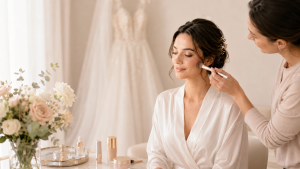
The wedding day goes by quickly.
After months of decisions, choices, meetings, fittings, messages and details, the moment finally arrives to live everything that has been carefully prepared. But precisely because it is such an important day, it is natural for nerves, anxiety and some fear that something might go wrong to appear.
The truth is that a stress-free wedding does not depend on everything going exactly as imagined.
It depends, above all, on having organisation in place before the day, a realistic timeline, well-delegated tasks and some margin to deal with small unforeseen events.
On the day itself, the bride should not be worried about dealing with suppliers, confirming schedules, looking for accessories, solving delays or reminding everyone of what they need to do. That work should be prepared beforehand.
The goal is simple: to create conditions so that the bride can be present, calm and comfortable, from the morning preparations until the end of the celebration.
A well-thought-out checklist helps a lot. It allows you to organise schedules, makeup, hair, dress, photos, transport, food, an emergency kit and people responsible for each detail.
More than controlling everything, the checklist serves to free the bride.
In this article, I share a practical organisation to prepare the wedding day with more calm, fewer last-minute decisions and more space to live the moment.
The secret is to prepare beforehand, not to control on the day
One of the biggest mistakes in wedding planning is leaving too many decisions for the actual day.
On the wedding day, everything seems to happen faster. People are arriving, messages on the phone, suppliers confirming details, emotional family members, photos, schedules to follow, the bride’s preparation, travel and small natural unforeseen events.
Because of this, the bride should not be the person responsible for controlling everything.
On this day, the priority should be living the moment.
Organisation should happen beforehand: in the week prior, in the days before and, whenever possible, the day before. The more decisions are already made, the less pressure there is on the day itself.
This does not mean trying to predict everything in detail. No wedding is completely immune to delays, changes of plans or small unforeseen events. But when there is a clear structure, everything becomes easier to handle.
The difference lies in knowing who does what.
Who answers the phone if a supplier needs information?
Who knows where the rings are?
Who brings the emergency kit?
Who controls the dressing time?
Who talks to the photographer?
Who stays with the bride if there is a delay?
These answers should be defined beforehand.
The bride should not be the central point of all logistical decisions. She should have trusted people around her, capable of filtering problems, solving small situations and protecting the calm of the morning.
It is also important to accept that the day may not be perfect to the minute.
There may be a small delay. Someone may forget something. Hair may take longer than expected. A photo may need more time. It may rain. It may be hotter than expected.
None of this needs to ruin the day.
The secret is to leave margin.
A timeline that is too tight increases stress. A timeline with breathing space allows unforeseen events to be handled better without turning everything into a rush.
Organising the wedding day without stress is not about controlling every second. It is about preparing the essentials so that, when something goes off plan, there is space to adjust.
The bride should feel that she does not have to be in management mode.
She should be able to eat calmly, breathe, talk, get emotional, laugh, do her makeup, get dressed and live the morning without constantly looking at the clock or her phone.
That is why the preparation beforehand is so important.
The fewer decisions left for the day itself, the lighter the experience will be.
One week before: confirm everything you can
The week before the wedding is an important phase.
This is when many details should stop being “in your head” and become organised, written down and shared with the right people.
Confirming everything in advance helps avoid messages, doubts and last-minute decisions on the actual day.
Start by reviewing the overall wedding timeline: start time for hair and makeup, photographer arrival time, dressing time, departure to the ceremony, ceremony start, photos, cocktail, dinner and key moments of the celebration.
Even if there is a wedding planner, it is useful for the bride to know that the structure is finalised and that the responsible people have access to the information.
Then confirm schedules and addresses with the main suppliers.
Makeup artist, hairstylist, photographer, videographer, transport, florist, venue or space, church or ceremony location, music and other suppliers should have clear information: where they need to be, what time, who they should speak to and the contact person for the day.
This contact should ideally not be the bride.
It can be the wedding planner, a bridesmaid, a sister, a close friend or a family member with an organised and calm profile.
The week before is also the right time to confirm the arrival time of the makeup artist and hairstylist, especially if there are more people getting ready in the same place.
The bride’s mother, bridesmaids or other guests may need hair and makeup. In these cases, it is essential to know how many people will be prepared, in what order and how much time will be needed.
The bride should have margin.
She should not be ready right at the deadline. There should be time to get dressed, adjust accessories, put on the veil, take photos and handle any small detail without rushing.
It is also important to review all the items the bride will use: dress, shoes, lingerie, jewellery, veil, perfume, hair accessories, robe or outfit for getting-ready photos and any special detail.
Everything should be gathered in an easy-to-find place.
If there are rings, vows, documents, pending payments or envelopes for suppliers, they should also be identified and handed over to the responsible person.
In the week before, it is best to avoid major changes.
It is not the ideal time to try a new skincare routine, drastically change your hair, test self-tanner for the first time, do aggressive treatments or change important decisions unnecessarily.
The simpler and more predictable this week is, the better.
The goal is to finalise details, not open new doubts.
Good organisation in the week before allows the wedding morning to start with much more calm.
Prepare a realistic timeline for the day
The timeline is one of the most important tools for organising a stress-free wedding day.
But for it to work, it needs to be realistic.
On the wedding day, almost everything takes longer than expected. Getting dressed may take longer. Photos may require more time. Someone may be late. Makeup may need adjustments. Traffic may be slower. Emotions may change the rhythm of everything.
Therefore, a good timeline should not be made minute by minute.
It should have margin.
Instead of organising the morning as a tight sequence of tasks, it is better to create time blocks with breathing space.
The bride’s preparation should include time for makeup, hair, dressing, accessories, detail photos, portraits, photos with family or bridesmaids and travel to the ceremony location.
If there are several people doing hair and makeup, that time should be carefully calculated. It is not enough to add up each person’s minutes. It is necessary to consider entries and exits, space preparation, touch-ups, breaks and small delays.
The bride should be ready before the moment she actually needs to leave.
This margin is essential.
If the ceremony is at 3:00 pm and the travel takes 20 minutes, it does not make sense to finish preparations at 2:40 pm. There should be time to get dressed calmly, breathe, take photos, handle details and leave without feeling rushed.
It is also important to share the timeline with the right people.
Photographer, videographer, makeup artist, hairstylist, wedding planner, bridesmaids and the person responsible for logistics should know the main times. This way, everyone works with the same reference.
The timeline is not meant to create pressure. It is meant to provide guidance.
When everyone knows what is going to happen, there are fewer questions, fewer interruptions and fewer last-minute decisions.
Simple example of a morning bride timeline
This example should always be adapted to the ceremony time, location, number of people and type of preparation:
- 08:30 — Light breakfast and start of space preparation;
- 09:00 — Start of hair and makeup for family or bridesmaids;
- 10:30 — Photographer/videographer arrival for details and atmosphere;
- 11:00 — Start of bride’s makeup;
- 12:15 — Start or completion of bride’s hair, depending on the order defined;
- 13:00 — Final makeup and hair touch-ups;
- 13:20 — Get dressed, put on jewellery, shoes and veil;
- 13:50 — Photos of the ready bride and family moments;
- 14:20 — Final touch-ups and preparation to leave;
- 14:30 — Departure to the ceremony.
This is only an example.
The most important thing is that there is time between each moment. A timeline that is too ambitious can turn the morning into a rush. A timeline with margin allows everything to be lived more calmly.
And calm shows.
It shows in the face, in the photographs, in posture and in the way the bride remembers the day.
Organise the wedding morning calmly
The wedding morning is one of the most special moments of the wedding.
It is the start of the day. The moment when everything begins to feel real. There is emotion, anticipation, details, close people, photographs and preparation.
Because of this, it is worth creating the most peaceful environment possible.
The space where the bride gets ready should be chosen carefully. Ideally, it should have good natural light, enough space, a table or area for makeup and hair, available sockets, a mirror and some organisation.
A room that is too full, dark or messy can make the preparation more difficult and less peaceful.
It is also important to control the number of people present.
Having close people around can be very beautiful, but too many people in the same space can create noise, questions, opinions and distractions. The bride should choose who she truly wants with her in that moment.
The morning should be protected.
Whenever possible, the bride should not be answering supplier calls, replying to logistical messages or solving questions about schedules. Those tasks should be delegated.
The phone can be kept by someone trusted or, at the very least, used only for essentials.
It is also important to have water and some light food available.
With nerves, many brides forget to eat or drink. But going many hours without eating can increase tiredness, weakness or anxiety. Small snacks, fruit, nuts, toast, yoghurt or something simple can help.
Before the arrival of the makeup artist, hairstylist or photographer, the main items should be accessible: dress, shoes, jewellery, perfume, veil, invitations, rings, bouquet, robe and other details that may be photographed.
This avoids having to search for everything in a rush when the photographer arrives.
The outfit worn during preparation should also be considered. A robe, shirt or front-opening piece helps avoid messing up hair and makeup when it is time to change into the dress.
Small details like this make a difference.
The bride’s morning should not be just a list of tasks. It should be an experience.
With organisation, margin and a calm environment, it becomes easier to live that moment with presence. To laugh, get emotional, talk, breathe and get ready without feeling that everything is running late.
Hair and makeup are part of that experience.
When there is enough time, the process becomes more comfortable, adjustments are made calmly and the bride feels more confident about the result.
At its core, organising the bride’s morning is about creating space for the day to start well.
And a calm start can influence the rest of the wedding.
Plan makeup and hair with margin
Makeup and hair are two of the most important moments of the wedding morning.
Not only because of the final result, but also because of how they influence the rhythm of the day. When these moments are well planned, the morning feels calmer. When the schedule is tight, even small delays can create anxiety.
That is why makeup and hair should be organised with margin.
They should not be timed minute by minute, as if everything will go smoothly without pauses, questions or adjustments. On the wedding day, interruptions, emotions, photos, people coming in and out, touch-ups, conversations and small details are normal and take time.
The bride should be ready before the final deadline.
This is very important. The time when hair and makeup are finished should not coincide with dressing, leaving or starting important photos. There should be space to breathe, look at the result, make small adjustments, put on accessories, get dressed calmly and be photographed without rush.
If there are other people getting hair and makeup done, such as the bride’s mother, bridesmaids or close family members, organisation must be even more careful.
It is important to define:
- how many people will be getting ready;
- who does makeup;
- who does hair;
- the order of each person;
- how much time will be needed;
- who needs to be ready first;
- what time the photographer arrives;
- what time the bride must be fully ready.
The bride should not always be the last person to get ready. In some cases, it makes sense for her to be ready earlier for photos, dressing or family moments.
A hair and makeup trial helps a lot in this process.
When the look has already been tested beforehand, there are fewer decisions on the day. The bride already knows what to expect, the makeup artist knows the skin and preferences, and the process becomes more secure.
The wedding day is not the ideal moment to try a completely different makeup, a new hairstyle or an idea that has never been tested.
It is also not the moment to introduce unknown skincare products, last-minute treatments or radical hair changes.
The more predictable the beauty preparation is, the calmer the morning will be.
Hair and makeup should be seen as part of the day’s organisation, not just an aesthetic detail. They need time, space, good light and calm.
When everything is planned with margin, the final result is better — and the bride feels more confident.
Prepare everything the bride will use
One of the biggest sources of stress on the wedding morning is searching for things at the last minute.
The dress is in one room, the shoes in another, the earrings in a box, the perfume in a bag, the veil hanging elsewhere and the robe still not ironed.
Small details, when scattered, can create confusion.
That is why everything the bride will use should be prepared and gathered before the day, or at least the day before.
The ideal is to organise a specific area with all important items:
- dress;
- veil;
- shoes;
- lingerie;
- jewellery;
- hair accessories;
- perfume;
- robe or outfit for getting-ready photos;
- second pair of shoes, if needed;
- bouquet, when it arrives;
- rings, if they are with the bride;
- vows or documents, if needed;
- lipstick or touch-up product;
- any symbolic or family detail.
This organisation helps the bride, but also helps the suppliers.
The photographer can capture details without interrupting the preparation. The makeup artist and hairstylist can work with less noise around them. The people helping the bride get dressed know where everything is.
It is also important to think about the outfit worn during preparation.
A robe, loose shirt or front-opening piece helps avoid messing up hair and makeup when it is time to get dressed. It is a simple but very useful detail.
Shoes should be ready and, if possible, already slightly worn before the wedding. Brand new shoes can cause discomfort or blisters, especially on a day when the bride will be on her feet for many hours.
Lingerie should also be tested with the dress.
It should not mark, show or create discomfort. It is best to confirm everything beforehand to avoid surprises on the day.
Jewellery and accessories should be chosen and set aside.
On the wedding day, small decisions can feel bigger than they really are. Choosing between two pairs of earrings, deciding whether to wear a bracelet, or searching for hairpins can create unnecessary tension.
Everything that can be decided beforehand should already be decided.
It is also worth preparing items for detail photography. Invitations, perfume, shoes, rings, jewellery, flowers, veil or other special elements should be accessible when the photographer arrives.
This avoids interrupting makeup and hair to search for objects.
The wedding morning should flow.
And it flows much better when the details are prepared.
Emergency kit for the wedding
Even with excellent organisation, small unforeseen events can happen.
A shoe that hurts, a loose thread, a small stain, a headache, heat, tears, hunger, a button that needs adjusting or a quick makeup touch-up.
That is what the emergency kit is for.
The kit does not need to be huge, but it should include practical items that can solve small situations without creating stress.
Ideally, this kit should not stay with the bride. It should be with a bridesmaid, friend, sister, wedding planner or the person responsible for the day’s logistics.
This way, when something is needed, someone knows exactly where everything is.
An emergency kit may include:
- tissues;
- cotton buds;
- plasters;
- blister pads;
- usual painkillers;
- personal medication;
- water;
- light snacks;
- lipstick for touch-ups;
- blotting powder or paper;
- mini deodorant;
- small perfume;
- brush or small comb;
- hairpins and elastics;
- safety pins;
- needle and thread;
- double-sided tape;
- wipes;
- phone charger;
- power bank;
- mints or sweets;
- nail file;
- nail glue, if needed;
- stain remover in appropriate format;
- copy of important contacts.
For makeup, it is usually not necessary to bring many products.
If makeup has been well prepared, touch-ups are usually simple: lips, shine control and possibly small adjustments after tears or many hours of celebration.
A lipstick similar to the one used is a good idea. Blotting paper or compact powder can also help, especially in summer weddings or for skin that tends to shine.
Tissues are essential.
During the ceremony, vows, hugs or speeches, it is very normal to feel emotional. Having tissues nearby avoids last-minute searching.
Blister pads are also very useful. Even comfortable shoes can become difficult after many hours.
The emergency kit is not about expecting problems. It is about creating peace of mind.
Knowing that there is a solution for small unforeseen issues helps the bride relax.
Delegate tasks before the wedding
On the wedding day, the bride should not be the person who solves everything.
Even if she is organised, detail-oriented and used to controlling every step, this is the day to delegate.
Delegating does not mean losing control. It means trusting the right people to protect the bride’s calm.
There are tasks that should have designated responsible people before the day:
- answering supplier calls;
- confirming schedules;
- keeping important contacts;
- bringing the emergency kit;
- knowing where the rings are;
- controlling the morning timeline;
- signalling when it is time to get dressed;
- talking to the photographer or videographer;
- organising family members for photos;
- keeping documents safe;
- handing over envelopes or pending payments;
- accompanying the bride during transfers;
- collecting items at the end of the day;
- ensuring the dress, veil or accessories are safely stored afterwards.
These tasks may seem small, but together they create a lot of noise.
If every question reaches the bride, the morning becomes more tiring.
The ideal is to choose one or two trusted people who are calm and practical. People who can solve issues without drama, filter information and make small decisions when needed.
Not everyone has this profile.
A very anxious person may increase tension. A very emotional person may not be ideal for managing schedules. An unorganised person may forget important details.
That is why the choice should be made with care, but also realism.
The responsible person should have access to the timeline, supplier contacts, addresses, schedules and task list. They should also know what should or should not be brought to the bride.
Not every problem needs to reach the bride.
If a supplier is five minutes late, if a table needs confirmation, if someone asks where to park or there is a simple logistical question, it can be solved without interrupting the preparation.
The bride should be protected from unnecessary noise.
This is one of the biggest secrets to a calmer day.
When tasks are delegated, the bride can focus on living the moment: getting ready, feeling emotions, being with close people and arriving at the ceremony with more calm.
Avoid last-minute beauty decisions in the final week
The week of the wedding is not the ideal time for major beauty experiments.
It is natural to want to arrive on the day with the best possible skin, hair and overall look. But trying to fix everything in the last few days can increase stress and the risk of irritation or unexpected results.
At this stage, the best approach is to stick to what is already tested.
It is not advisable to try new skincare products, do aggressive treatments, radically change hair colour, test self-tanner for the first time or decide on a completely different makeup look from the trial.
The skin may react to new products with redness, breakouts, burning, peeling or sensitivity. Even a very good product may not suit a specific skin type, especially during a more stressful period.
Treatments such as peels, deep cleanses, laser or intensive exfoliation should be planned in advance. Close to the wedding, they may leave the skin sensitive, marked or uneven, making makeup application more difficult.
The same applies to hair.
Radical colour changes, unexpected cuts or treatments that significantly alter texture should be avoided close to the date. If something goes wrong, there may not be time to fix it calmly.
Self-tanner also requires caution.
If it has never been tested before, it can cause patchiness, uneven tone, transfer to clothing or a darker result than expected. If the bride wants to use it, she should test it well in advance.
In the wedding week, the routine should be simple.
Hydrating the skin, sleeping as well as possible, drinking water, avoiding harsh products and maintaining familiar care routines is often the best strategy.
Bridal makeup should be built on calm skin, not skin irritated by last-minute experiments.
It is also important to trust the makeup trial.
If the look was chosen and refined beforehand, there is no need to completely change it on the day because of something seen on social media. Small adjustments are fine, but the main direction should already be defined.
Beauty decisions should bring confidence, not doubt.
The fewer experiments in the final week, the more likely the bride will arrive at the day with calmer skin, hair and mind.
Do not forget food and hydration
On the wedding day, it is very easy to forget the basics.
Between hair, makeup, photos, dress, family, emotions and schedules, many brides go too many hours without eating or drinking water. It is not always intentional. The day simply speeds up and everything feels urgent.
But food and hydration make a difference.
Going many hours without eating can increase feelings of weakness, dizziness, irritability or anxiety. It can also make the morning more exhausting, especially in warm weather or emotionally intense moments.
The ideal is to start the day with a light, simple and comfortable meal.
It does not need to be anything heavy. It should be something familiar that the bride knows sits well with her. The important thing is to avoid spending the morning only on coffee or without any food.
It is also helpful to have small snacks available during preparation.
Fruit, nuts, simple biscuits, toast, yoghurt, bars or other practical foods can help maintain energy without discomfort. Ideally, these should be easy to eat, not messy, not strongly scented and not disruptive to makeup.
Water should also be close by.
With nerves, many brides forget to drink. But hydration supports the body, skin and overall wellbeing. On hot days, outdoor weddings or long ceremonies, this becomes even more important.
It can be helpful to ask a bridesmaid, sister, friend or family member to remind the bride to drink water and eat something during the morning.
It sounds like a small detail, but it makes a difference.
The bride should not arrive at the ceremony feeling tired, weak or as if she has been rushing all day. The preparation should include moments to breathe, eat slowly and drink water.
It is also best to avoid excess.
On the wedding morning, it is not the right time to try new foods, unusual drinks or heavy meals. The goal is comfort, energy and stability.
As with skincare, it is best to stick to what already works.
A calm morning also comes from taking care of the body in simple ways.
Eating, drinking water and taking small breaks help the bride feel better, more present and more ready to experience the day.
Make time for relaxed photography
Photography is part of the wedding memory.
It captures details, emotions, people, gestures and moments that often pass too quickly on the day itself.
That is why it is important to set aside time for relaxed photography, especially during the bride’s morning.
The preparation is a beautiful moment to photograph: the dress, shoes, perfume, jewellery, bouquet, veil, invitations, final touch-ups, makeup, hair, robe, family reactions and the first portraits of the bride ready.
But these photos need time.
If makeup ends late, if the dress is rushed or if the departure is too tight, the photos become quicker, more tense and less natural.
A realistic timeline should include time for the photographer to work calmly.
It is not necessary to turn the morning into a long or rigid photoshoot. But there should be space to capture key moments without constantly interrupting the preparation.
It also helps to have all items organised before the photographer arrives.
Dress, shoes, perfume, jewellery, rings, invitations and accessories should be accessible. This avoids searching for things while the bride is getting her hair and makeup done.
After hair and makeup, there should be time to get dressed calmly.
Some dresses are simple to put on. Others require buttons, ties, hooks, veil placement, adjustments, several helpers or special care. This can take longer than expected.
Once dressed, the bride may need a few minutes for final touch-ups.
Makeup may need adjusting after getting dressed. Hair may need slight fixing. The veil may need careful placement. Accessories may need adjusting.
Only then is the bride truly ready for photos.
It is also important to reserve time for photos with close people: parents, siblings, bridesmaids, grandparents or special friends. These moments are often emotional and should not be rushed.
Calm shows in photographs.
When there is time, expressions feel more natural, gestures become lighter and the bride can live the moment without feeling rushed.
Photos should not take over the morning. But they should have space within it.
In the future, these small moments are often what bring the beginning of the day back most vividly.
Have a plan for small unforeseen events
Even with very careful planning, unforeseen events can happen.
A small delay, a stain, a loose seam, an unexpected blemish, rain, heat, traffic, tears, a supplier needing confirmation or a photo taking longer than expected.
This is part of it.
The goal should not be to eliminate all unforeseen events, because that is impossible. The goal should be to ensure that small problems do not take on more importance than they actually have.
For that, having a simple plan helps.
First, there should be a person responsible for filtering situations. The bride does not need to know about every small delay or logistical doubt. If something can be resolved by someone else, it should be handled without interrupting the preparation.
Second, there should be buffer time in the schedule.
The buffer is what turns an unforeseen event into a small adjustment, instead of turning it into a source of stress. If everything is planned down to the minute, any delay creates pressure. If there is space between moments, everything is resolved more calmly.
Third, there should be an emergency kit.
Tissues, safety pins, double-sided tape, plasters, lipstick, blotting paper, water, snacks, personal medication, and a charger can solve many small situations.
It is also important to accept that some things may not happen exactly as planned.
It may rain for a few minutes. It may be necessary to change the location of some photos. Someone may arrive late. The hair may need a bit more touch-up. The departure may be slightly delayed.
None of that defines the wedding.
The day will be remembered for emotions, for the people, for the ceremony, for the celebration, and for the moments lived — not for each small logistical detail.
When an unforeseen event arises, the best attitude is to stop, breathe, and understand whether it is truly important or just a detail.
Often, what seems enormous in that moment will not even be remembered afterward.
The bride should be surrounded by people who help put things into perspective, not people who increase tension.
This point is very important.
A calm team, experienced vendors, and close people with good energy make a big difference on the wedding day.
The contingency plan does not need to be complex. It only needs to answer three questions:
Who handles it?
How much buffer time is there?
What do we have prepared to help?
If these answers are clear, the day becomes lighter.
Final checklist for the wedding day
To simplify organisation, this checklist can help confirm the main points before the big day.
It does not need to be seen as a rigid list. It should serve as support so that nothing important is forgotten.
Before the wedding day, confirm:
- final timeline of the morning and the event;
- makeup artist arrival time;
- hair stylist arrival time;
- photographer and videographer arrival time;
- main vendor contacts;
- full venue addresses;
- person responsible for receiving vendors;
- person responsible for managing schedules;
- person responsible for the rings;
- person responsible for the emergency kit;
- bride’s transportation;
- estimated travel time;
- backup plan for rain, heat or unforeseen events;
- dress prepared and hanging;
- veil, shoes and lingerie;
- jewellery and hair accessories;
- perfume;
- robe or getting-ready outfit;
- bouquet and delivery time;
- invitations or photo details;
- necessary documents, if applicable;
- vows, if any;
- envelopes or pending payments;
- snacks and water for the morning;
- lipstick or touch-up product;
- powder or blotting paper;
- tissues;
- plasters and blister plasters;
- personal medication;
- charger or power bank;
- time reserved for photos;
- time to get dressed calmly;
- buffer before departure;
- someone responsible for collecting items at the end.
It can also be useful to prepare a small bag or box with essential items and label it.
Everything important should be in a place known by the right people. The bride should not have to repeatedly answer the question “where is this?”.
The simpler the information, the better.
A well-organised checklist does not exist to make the day mechanical. It exists to free mental space.
When the essentials are prepared, the bride can experience the morning with more presence, fewer interruptions and more calm.
Conclusion: the day should be lived, not managed
The wedding day does not need to be perfect to the minute to be beautiful.
In fact, the most peaceful weddings are not those where nothing changes or nothing goes wrong. They are those where there is enough preparation so that small unforeseen events do not take the bride out of the moment.
Organising the wedding day without stress involves preparing in advance, confirming details, creating a realistic timeline, delegating tasks and leaving buffer time.
The bride should not be the event manager on the day itself. She should have trusted people around her, aligned vendors and a clear structure so she can simply live the experience.
The bride’s morning should be calm, cared for and special.
There should be time for makeup, hair, dressing, photos, food, water, emotions and small silences. Time to breathe. Time to look in the mirror. Time to feel that the day has arrived.
Makeup, hair, the dress and all the details are part of that preparation, but they should not become a source of pressure.
When everything is organised in advance, the beauty of the day happens more naturally.
The most important thing is that the bride feels comfortable, secure and present.
Because, in the end, a wedding is not a checklist of tasks to complete. It is a day to live, remember and feel.
Frequently asked questions about organising a stress-free wedding day
When should I prepare the wedding day checklist?
The ideal time is to start preparing the checklist a few weeks before the wedding and review it in the week before.
At that stage, schedules, vendors, locations and main details are usually already defined. This makes it possible to organise the information, delegate tasks and avoid last-minute decisions.
Who should be responsible for vendors on the day?
It should be someone trustworthy, organised and calm.
It can be a wedding planner, bridesmaid, sister, close friend or family member capable of handling small situations without creating stress. The bride should not be the main point of contact for vendors on the day itself.
How much time should I allocate for makeup and hair?
It depends on the chosen look, the number of people being prepared, the location and the day’s logistics.
The most important thing is to leave buffer time. Makeup and hair should not finish right before getting dressed or leaving. There should be time for adjustments, photos, getting dressed calmly and small unforeseen events.
What should the bride’s emergency kit include?
The kit may include tissues, cotton buds, plasters, blister plasters, usual painkillers, personal medication, water, snacks, lipstick for touch-ups, blotting paper, powder, safety pins, thread and needle, double-sided tape, charger and power bank.
Ideally, this kit should be kept by a responsible person, not directly with the bride.
What should I avoid in the week before the wedding?
In the week before the wedding, you should avoid new products, aggressive treatments, drastic hair changes, untested self-tanning, intense exfoliation and last-minute major decisions.
The best approach is to keep a simple, familiar and safe routine.
How can I reduce stress on the wedding morning?
Prepare everything the day before, delegate contacts and tasks, choose a calm space for getting ready, eat something light, drink water and follow a realistic timeline.
It also helps to limit the number of people in the bride’s space and avoid having every problem reach her directly.
Should the bride have makeup done first or last?
It depends on the day’s organisation.
In some cases, the bride may be made up closer to the end to keep the look fresh. In others, it may make sense to prepare her earlier to ensure time for dressing, photos and touch-ups.
The most important thing is that the bride is ready with enough buffer time before departure or main photos.
How can I ensure there is enough time for photos?
The timeline should include a dedicated block for photos.
It is not enough to only account for makeup and hair time. You need to reserve time for detail shots, getting dressed, bridal portraits, photos with family or bridesmaids and the departure to the ceremony.
What should I do if there is a delay on the wedding day?
The first step is not to panic.
There should be a person responsible for assessing the situation and adjusting the timeline if needed. Often, small delays can be compensated with built-in buffer time or by reorganising some photos.
The bride should only be involved if it is truly necessary.
Are you planning your wedding?
Organising the bride’s morning makes a big difference in how the day is experienced.
With a well-thought-out timeline, a makeup trial, defined schedules and buffer time for small unforeseen events, everything becomes lighter and calmer.
Filipa Villar Afonso provides personalised bridal makeup, designed for the face, style, skin and rhythm of the day.
If you are planning your wedding, you can learn more about the bridal makeup service and send your details to receive a personalised proposal.